
 By
By 
Few British films have courted as much controversy, laughter, and accidental theological debate as Monty Python’s Life of Brian. Released in 1979, it arrived like a comedic thunderbolt, splitting the establishment down the middle while uniting the Pythons in their most cohesive dramatic effort.
Today, it is regarded as a satirical masterpiece, but as Michael Palin and Terry Gilliam recall in a 2019 interview with The Guardian, the path to the Mount of Olives was paved with financial ruin, “grimy” aesthetics, and a legendary $5 million “admission ticket” from a Beatle.
The genesis of the project was as irreverent as the film itself. While the troupe was riding the wave of success from their previous feature, the seeds for a biblical epic were planted during a press junket.
Palin remembers the exact moment the lightning struck: “We were on a publicity tour in Amsterdam for Monty Python and the Holy Grail when Eric Idle came up with the title Jesus Christ: Lust for Glory. We all laughed: ‘We could never do that!’ But we liked the challenge of doing a film about religion. Then someone suggested it be set around the time when Jesus was alive, but it’s a case of mistaken identity. Someone who’s thought to be the Messiah, but spends the whole film protesting that he isn’t.”
This shift from parodying Jesus himself to lampooning the followers and the political climate of 1st-century Judea gave the team the creative runway they needed. To pull it off, the Pythons departed from their usual fragmented writing process.
“Generally speaking, the Pythons wrote in separate groups who came together later,” Palin explains. “We ended up in Barbados for two weeks and got a lot of the script done there – the linking up of the various sketches. It gave the script a great clarity that Holy Grail and The Meaning of Life don’t have.”
Finding the backing
However, the “clarity” of the script proved terrifying to the money-men. Just as the production was gearing up, the original financiers, EMI, read the screenplay and promptly bolted, fearing a blasphemy scandal. It was a “mortal blow,” according to Palin, as the team was already in pre-production. Enter the “Quiet Beatle” and a loud Python devotee.
“Eric went to Hollywood and pitched it to George Harrison, who had been a huge Python fan since the first TV programme,” Palin says. “He pawned his house and arranged a loan of $5m. When he was asked why, he just said: ‘Because I want to see it.’ Not many people pay $5m for an admission ticket.”
With the funding secured by the world’s most expensive cinema seat, the production moved to Tunisia. While Terry Jones took the director’s chair solo this time, Gilliam — who had co-directed Holy Grail — was happy to step back and focus on the appaearance of the ancient world. For Gilliam, the comedy only worked if the environment felt oppressive and authentic.
“I just wanted to concentrate on the look of it. It was very important to keep it feeling real and dirty and decayed,” Gilliam says. “By making everything so grimy and unpleasant, it made the humour funnier. We did most of the shooting in Sousse, Tunisia, and the ribat in Monastir; it looked fantastic, but we added various things like the ramp and the portico where Pilate and Biggus Dickus try to ‘welease Wodewick’.”
Gilliam’s dedication to the grotesque extended to his own performances. While the other Pythons often fought to avoid the more physically taxing or ugly roles, Gilliam leaned into them. “Directing Python was hard work, because people didn’t like to be uncomfortable: they didn’t like to wear beards or uncomfortable costumes. Those, to me, were important elements, and I didn’t want to have to fight for that stuff… I loved playing the jailer. It was another case of I’ll do a grotesque character – skull split open, wearing awful stuff – because the others wouldn’t.”
Casting the lead role of Brian, however, was a point of internal contention. John Cleese had his eye on the part, but the group ultimately decided on Graham Chapman. It was a pivotal choice, as Chapman was battling significant personal demons at the time.
“John Cleese had wanted to play Brian,” Palin reveals. “Graham Chapman had been drinking quite a lot, and John thought we needed a safe pair of hands for the lead role. But Graham gave up drinking just before and was dry throughout. He had a kind of decency that anchored the whole film. He was also a qualified doctor, so he was very useful looking after cast and crew while we were shooting in Tunisia, with all the stomach upsets people had.”
Iconic moments
One of the film’s most iconic moments, the Biggus Dickus scene with Pontius Pilate, relied on that very decency and a monumental effort to stay in character. Palin, playing Pilate, had to maintain a deadly serious façade while a line of Roman guards struggled to keep it together.
“The most difficult thing to shoot was the Pontius Pilate scene because it had to be structured around continuous suppressed laughter. All the centurions had to be on the verge of cracking up, while Graham and I had to remain totally straight-faced. It was really hard work. On the various takes, I used to have to think of a silly word to whisper into someone’s ear. It worked very well, but there’s one take where I’m nose to nose with Chris Langham and we both crack up, and I’m not fully turned away from the camera.”
Despite the meticulous preparation, the Pythons were famously rigid about their scripts. While the jailer scene offered a rare moment of spontaneity, performances were typically kept on a tight leash. “That sequence with Mike [Palin] and Eric was one of the few instances of ad libbing,” Gilliam notes. “Python didn’t ad lib because John didn’t like it – he’s a fundamentalist when it comes to humour, ironically.”
Causing a stir

The Monty Python comedy troupe.
Upon its release, the film didn’t just cause a stir; it caused a global protest. It was banned in Ireland, Norway, and across numerous UK councils. The irony of the outrage was not lost on Gilliam, whose own mother remained unfazed.
“The protests in New York were really vigorous. We managed to get the Catholics, the Protestants and the Jews all pissed off at us. The crucifixion scene did it every time. Christians seem to take crucifixion as theirs alone, never mind that it was done to a lot of non-Christians. My own mother, who was a real churchgoer, couldn’t see what people were getting angry about, because it was about somebody else called Brian. It wasn’t blasphemy.”
For Palin, the peak of the absurdity came during a televised debate on the BBC’s Friday Night, Saturday Morning, where he and Cleese faced off against the Bishop of Southwark and Malcolm Muggeridge. The experience was a turning point in British cultural history.
“We wanted to explain why it wasn’t a film denigrating Jesus in any shape or form. So to get there and find that they were the ones who were behaving like little children, playing to the crowd and saying, ‘You’re going to get your 30 pieces of silver’ was unbelievably irritating. That interview was a huge turning point: it helped break the assumption that religion was something the establishment told people how to talk about. They’d embarrassed themselves by making a pathetic case.”
Decades later, Life of Brian remains as sharp as a Roman shortsword. Gilliam reflects on the film’s enduring relevance in a world that seems to be circling back toward the very absurdities they once parodied.
“I was very proud we achieved that much of a reaction. They were the people we were after: those who blindly follow religious diktats and don’t think for themselves. We made it 40 years ago, but it is so applicable to our world now. Which either says the world never really changes, or it just gets more absurd. There’s fundamentalism, there’s antisemitism… and then there’s Stan who wants to be a woman. Our headlines are about this stuff every day. The only difference now is people have lost a lot of their sense of humour.”
Through the lens of Brian’s accidental messiahship, the Pythons didn’t just make a comedy; they made a manifesto for individual thought. And as Palin and Gilliam’s memories attest, it took a Beatle’s house, a doctor’s sobriety, and a lot of Tunisian grime to teach the world to always look on the bright side of life.
Discover more on British cinema on Top 10 Films
The Bridge Of Death: A Terrifying Experience On The Set Of “Monty Python And The Holy Grail”
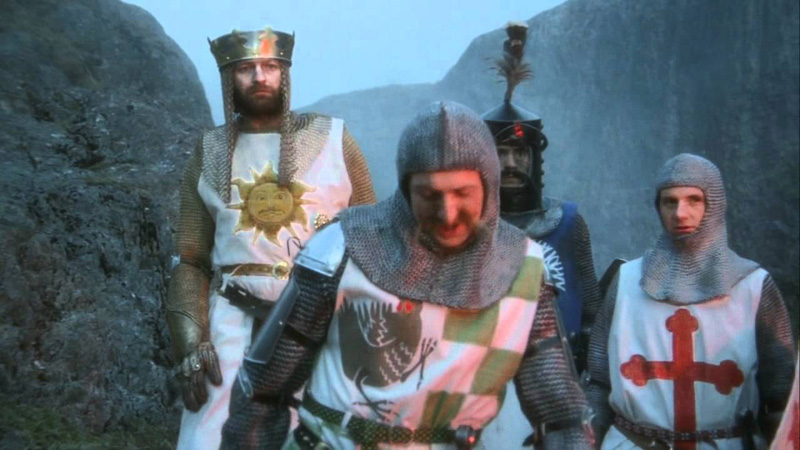
The Bridge of Death scene in Monty Python and the Holy Grail was hilariously perilous on screen, but behind the scenes, it was truly terrifying.






Comments