
 By
By 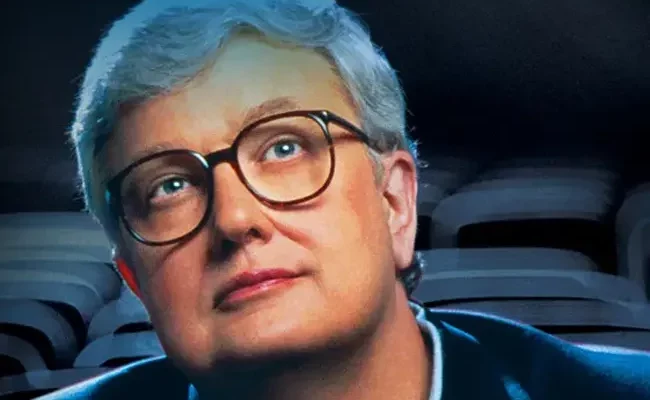
I shouldn’t have the affection for Roger Ebert that I do. After all, here was a man – a much celebrated film critic – who said lists were meaningless (in fact, he wrote a Wall Street Journal piece entitled “Why I Loathe Top 10 Films Lists“). But like his opinion on films – we didn’t always see eye to eye. That, however, mattered little in my appreciation of the Illinois-born writer’s ability to write a film review.
Who was Roger Ebert?
Acclaimed by not only his peers but even those filmmakers whose work, from time to time, he tore to pieces (Martin Scorsese’s Color of Money, for example), Ebert was driven by a basic commonality with his readership: an adoration of film.
Working as a movie critic for the Chicago Sun-Times (for which he wrote for from 1967 until his death in 2013), passion and intelligence shone brightly from every single one of his pieces. He adored the medium, articulately and entertainingly discussing his appreciation of the work of directors, actors, editors, composers and anyone attached to a film worthy of praise.

Roger Ebert pictured in the film about his life: Life Itself (2014).
Ebert was the first film critic to win the Pulitzer Prize for Criticism in 1975 and was described by Neil Steinberg of the Chicago Sun-Times as America’s “most prominent and influential film critic”.
His written work has inspired generations of film critics and theorists, many, like me, being particularly interested in the attention he played to the mechanics of story and character construction. Yet, my biggest compliment to him is simply: I wanted to write just like you.
What were Roger Ebert’s favourite movies?

Although Roger Ebert said he did not “believe in rankings and lists on the grounds that such lists are meaningless and might well change between Tuesday and Thursday”, he did make a couple of notable exceptions.
He compiled a top 10 list every year during his time with the Chicago Sun-Times, the legacy of which allows us to see his favourite movies every year from 1967 to 2012.
Popular choices include his first “number one” Bonnie and Clyde, alongside The Godfather (1972), Apocalypse Now (1979), Goodfellas (1990), and Almost Famous (2000). More leftfield choices include Costa-Gavras French-language political thriller Z (1969), Ingmar Bergman’s Scenes From A Marriage (1974), and Louis Malle’s My Dinner with Andre (1981).
Ebert also took part in Sight and Sound’s compilation of “best of” lists from leading film critics and those associated with the industry such as film directors Martin Scorsese, Quentin Tarantino and Woody Allen.
Below is Roger Ebert’s final top 10 list presented in chronological order. It is notable for the inclusion of Terrence Malick’s The Tree of Life, the only film released in the last 30 years to make the top 10.
We recommend
Life Itself is a moving and inspiring tribute to the late film critic Roger Ebert. Steve James’ feature-length documentary charts the career of the acclaimed Chicago Sun-Times film reviewer with new interviews conducted with Ebert shortly before his death as well as appearances from those who knew him best.
The Greatest Movies According to Film Critic Roger Ebert

The General
Dir. Keaton (1927)

What did Roger Ebert say:
“Today I look at Keaton’s works more often than any other silent films. They have such a graceful perfection, such a meshing of story, character and episode, that they unfold like music. Although they’re filled with gags, you can rarely catch Keaton writing a scene around a gag; instead, the laughs emerge from the situation; he was “the still, small, suffering center of the hysteria of slapstick,” wrote the critic Karen Jaehne. And in an age when special effects were in their infancy, and a “stunt” often meant actually doing on the screen what you appeared to be doing, Keaton was ambitious and fearless. He had a house collapse around him. He swung over a waterfall to rescue a woman he loved. He fell from trains. And always he did it in character, playing a solemn and thoughtful man who trusts in his own ingenuity.”
Roger Ebert’s full review of The General
Citizen Kane
Dir. Welles (1941)

What did Roger Ebert say:
“There is a master image in Citizen Kane you might easily miss. The tycoon has overextended himself and is losing control of his empire. After he signs the papers of his surrender, he turns and walks into the back of the shot. Deep focus allows Welles to play a trick of perspective. Behind Kane on the wall is a window that seems to be of average size. But as he walks toward it, we see it is further away and much higher than we thought. Eventually he stands beneath its lower sill, shrunken and diminished. Then as he walks toward us, his stature grows again. A man always seems the same size to himself, because he does not stand where we stand to look at him.”
Roger Ebert’s full review of Citizen Kane
Tokyo Story
Dir. Ozu (1953)

What did Roger Ebert say:
“Ozu is not only a great director but a great teacher, and after you know his films, a friend. With no other director do I feel affection for every single shot. “Tokyo Story” opens with the distant putt-putt of a ship’s engine, and bittersweet music evokes a radio heard long ago and far away. There are exterior shots of a neighborhood. If we know Ozu, we know the boat will not figure in the plot, that the music will never be used to underline or comment on the emotions, that the neighborhood may be the one where the story takes place, but it doesn’t matter. Ozu uses “pillow shots” like the pillow words in Japanese poetry, separating his scenes with brief, evocative images from everyday life. He likes trains, clouds, smoke, clothes hanging on a line, empty streets, small architectural details, banners blowing in the wind (he painted most of the banners in his movies himself).”
Roger Ebert’s full review of Tokyo Story
Vertigo
Dir. Hitchcock (1958)
What did Roger Ebert say:
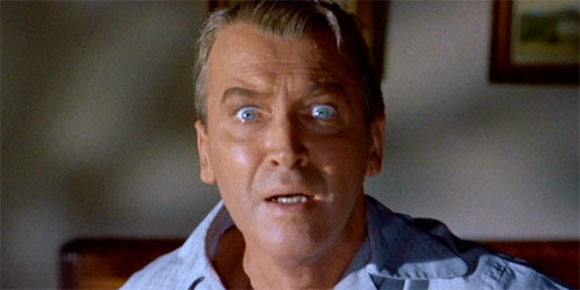
“There is another element, rarely commented on, that makes Vertigo a great film. From the moment we are let in on the secret, the movie is equally about Judy: her pain, her loss, the trap she’s in. Hitchcock so cleverly manipulates the story that when the two characters climb up that mission tower, we identify with both of them, and fear for both of them, and in a way Judy is less guilty than Scottie. The danger is to see Judy, played by Novak, as an object in the same way that Scottie sees her. She is in fact one of the most sympathetic female characters in all of Hitchcock.”
Roger Ebert’s full review of Vertigo
La Dolce Vita
Dir. Fellini (1960)
What did Roger Ebert say:
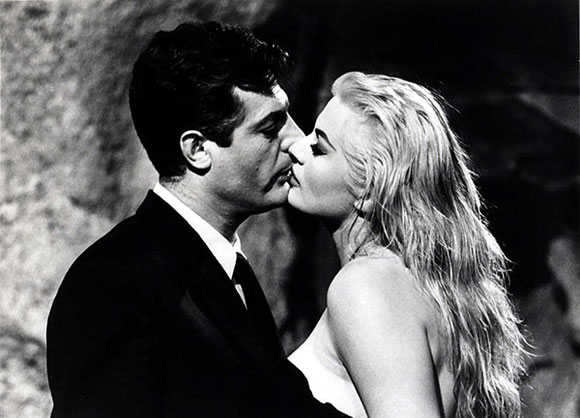
“The movie is made with boundless energy. Fellini stood here at the dividing point between the neorealism of his earlier films (like La Strada) and the carnival visuals of his extravagant later ones (Juliet of the Spirits, Amarcord). His autobiographical 8 1/2, made three years after La Dolce Vita, is a companion-piece, but more knowing: There the hero is already a filmmaker, but here he is a young newspaperman on the make.”
Roger Ebert’s full review of Vertigo
2001: A Space Odyssey
Dir. Kubrick (1968)

What did Roger Ebert say:
“Only a few films are transcendent, and work upon our minds and imaginations like music or prayer or a vast belittling landscape. Most movies are about characters with a goal in mind, who obtain it after difficulties either comic or dramatic. 2001: A Space Odyssey is not about a goal but about a quest, a need. It does not hook its effects on specific plot points, nor does it ask us to identify with Dave Bowman or any other character. It says to us: We became men when we learned to think. Our minds have given us the tools to understand where we live and who we are. Now it is time to move on to the next step, to know that we live not on a planet but among the stars, and that we are not flesh but intelligence.”
Roger Ebert’s full review of 2001: A Space Odyssey
Aguirre, Wrath of God
Dir. Herzog (1972)

What did Roger Ebert say:
“Of modern filmmakers, Werner Herzog is the most visionary and the most obsessed with great themes. Little wonder that he has directed many operas. He does not want to tell a plotted story or record amusing dialog; he wants to lift us up into realms of wonder. Only a handful of modern films share the audacity of his vision; I think of “2001: A Space Odyssey” and “Apocalypse Now.” Among active directors, the one who seems as messianic is Oliver Stone. There is a kind of saintly madness in the way they talk about their work; they cannot be bothered with conventional success, because they reach for transcendence.”
Roger Ebert’s full review of Aguirre, the Wrath of God
Apocalypse Now
Dir. Coppola (1979)

What did Roger Ebert say:
“The film has one of the most haunting endings in cinema, a poetic evocation of what Kurtz has discovered, and what we hope not to discover for ourselves. The river journey creates enormous anticipation about Kurtz, and Brando fulfills it. When the film was released in 1979, his casting was criticized and his enormous paycheck of $1 million was much discussed, but it’s clear he was the correct choice, not only because of his stature as an icon, but because of his voice, which enters the film from darkness or half-light, repeating the words of T.S. Eliot’s despairing “The Hollow Men.” That voice sets the final tone of the film.”
Roger Ebert’s full review of Apocalypse Now
Raging Bull
Dir. Scorsese (1980)

What did Roger Ebert say:
“Raging Bull is not a film about boxing but about a man with paralyzing jealousy and sexual insecurity, for whom being punished in the ring serves as confession, penance and absolution. It is no accident that the screenplay never concerns itself with fight strategy. For Jake LaMotta, what happens during a fight is controlled not by tactics but by his fears and drives.”
Roger Ebert’s full review of Raging Bull
The Tree Of Life
Dir. Malick (2011)

What did Roger Ebert say:
“Terrence Malick’s The Tree of Life is a film of vast ambition and deep humility, attempting no less than to encompass all of existence and view it through the prism of a few infinitesimal lives. The only other film I’ve seen with this boldness of vision is Kubrick’s 2001: A Space Odyssey, and it lacked Malick’s fierce evocation of human feeling. There were once several directors who yearned to make no less than a masterpiece, but now there are only a few. Malick has stayed true to that hope ever since his first feature in 1973.”
Roger Ebert’s full review of The Tree of Life
If you enjoyed reading about Roger Ebert’s top 10 films, you may also like to watch Steve James’ feature-length documentary, Life Itself, which charts the late film critic’s life and career.
“Life Itself” Is A Moving & Inspiring Tribute To The Late Film Critic Roger Ebert
Roger Ebert pictured in the film about his life: Life Itself (2014).
Steve James’ feature-length documentary charts the career of acclaimed Chicago Sun-Times film critic Roger Ebert with new interviews with Ebert himself as well as appearances from those that knew him best.











Siskel and Ebert is the show that started it all. Ebert was fat, Siskel was skinny. They often disagreed and at times they were annoying. But I tuned in every Saturday to listen to what they had to say.
Ebert was a great writer. Even the reviews you disagreed with were so well written that you have to admire him. I’ll post a few of my favourites from him. I’ll have to do this later as right now you I can’t get on his website…must be crashing.
This is a very sad day. Not because I knew him, but because cancer sucks.
A sad day indeed. Mr Ebert was not only a well respected film critic who told it like it was (and got paid for it!), but by all accounts, a really great guy to boot. He will be missed among the film blogging community, I am sure.
Looking down his list, it’s a shame he didn’t find more modern films to include, but the ones he HAS included, are certainly worthy entrants.
Sad news. I didn’t always agree with Ebert, but he will be missed. What I admire most is he kept writing reviews, even with all his health issues. RIP Roger Ebert.
Ebert’s top 10 has quite a few overlaps with the Sight & Sound top 50, it would appear.
I didn’t always agree with him on films but there’s no denying the fact that Roger Ebert knew more about film then most. A brilliant writer, he could break down the mechanics of a film and tell you why you like it, not just what it’s about. He was always engaging and passionate about films. Roger will be sadly missed by all. The rockstar of film journalism with a heart, two thumbs up in heaven with you.
I didn’t know he’d added Tree of Life into his most recent list. Interesting! RIP Mr Ebert!
A fascinating combination of films. Interesting that Tree of Life made it onto his final Top 10. Film criticism has suffered a great loss. Mr. Ebert will be missed.
That is one hell of a list. Thanks for sharing, Daniel.
The best film critic to ever live, imo, Roger Ebert, passed away much too soon. He was 70. I didn’t agree with him on a lot of the films he reviewed. But he was never jaded nor did he write for shock value. He reviewed based on his true feelings. He gave films like 1972’s Last House On The Left a positive review. Same with Booty Call and he was also one of the first to give a 4 star review to Halloween. He lost his fight with cancer, like so many do and that sucks. We’re all touched by someone who has it or know someone who has it. My mom was taken from me 7 years ago next month, from cancer. I have friends whose family is going through the same thing. Cancer is horrible and it hits us all. But on this day, just paying my respects to the best film reviewer I’ve ever read. RIP Ebert. Now you can go on arguing with Siskel while at the movies in the sky.
…”and now the balcony is closed forever” – Steven Spielberg
Here are his words and why he did no fear death:
http://www.salon.com…15/roger_ebert/
Mr Ebert had zero influence on me as a Film critic, but the news of his death is still very sad.
May he rest in peace.
While I had been aware of the existence of Roger Ebert for some years, in the pre-internet age (and living on the edge of the empire) I didn’t see his TV stuff until 1992 while on holiday in the UK.
Him and Siskel were reviewing The Hours and the Times. The quite funny exchange went something like this:
First guy (I suspect Siskel … my memory is a bit hazy on this point): Totally sensitive and moving movie about unrequited homosexual desire. Thumbs up.
Second guy (I suspect Ebert): That’s absolute rubbish. If this wasn’t about Lennon and Epstein it would be unmemorable crap. Thumbs down.
Admittedly I’m not totally familiar with his work, but my immediate reaction to Cloud Atlas when I saw it a few weeks back was more or less identical to his (he called it “the most ambitious movie ever made”.)
Plus a thumbs up to the man for putting the much maligned Sorcerer on his 1977 best 10 list. He was also a fan of Peckinpah’s Bring Me the Head of Alfredo Garcia when it was fashionable to pan it.
I’m going to track down his Last House on the Left Review … aside from the fact I didn’t like the film for reasons that had nothing to do with the murderous stuff (although it was pretty unpleasant), when Howard Thompson reviewed it for the NYT he admitted to walking out during the screening (as Janet Maslin did for the original Dawn of the Dead a few years later).
That could well be a comment on the difference between NY and Chicago film criticism.
It’s interesting to see this list for what it represents.
I feel that Ebert appreciate these films for their historic value, holding them as pieces of art that were, in one way or another, ahead of their time, advancing the medium and influencing a plethora of film makers and enthusiasts since their release. Having said that, I don’t think he chose them for this reason alone because knowing how honest he was with his writing, all of these probably were among his favorites for reasons prose may never fully convey.
I was actually not aware that he had included The Tree of Life in the latest iteration of the list and I can’t say I’m mad about it. Sure, it’s a controversial choice, like Citizen Kane probably would have been if he had made the list a couple of years after its release. Ebert, however, recognized something incredibly unique and valuable in The Tree of Life that I seem to have gotten as well. It’s as if, the film disintegrates in front of us and all that we are left with is pure emotion. This is something so rare, so unique and so difficult to accomplish that Ebert recognized its great artistry with this most honorable of mentions.
My personal tribute to Ebert will begin by watching the two big omissions I’ve made that are on this list of his: Tokyo Story and Aguirre, Wrath of God.
Thumbs up for this list!! I definitely need to see Citizen Kane soon.