
 By
By 
When Steven Spielberg’s The Sugarland Express hit theatres in 1974, audiences were captivated not just by its thrilling story but by a new level of cinematic intimacy and realism — particularly in the film’s car sequences.
At the heart of this innovation was the Panavision Panaflex camera, a lightweight, quiet, and versatile system that enabled filmmakers to capture complex tracking shots and synchronised dialogue in ways previously thought impossible.
While the camera’s debut would later influence Spielberg’s iconic work on Jaws, it was The Sugarland Express that first showcased its potential and marked a milestone in cinematography.
Prior to the Panaflex, shooting inside vehicles was a technical nightmare. Traditional cameras were bulky, noisy, and often required multiple setups to capture even simple interactions between characters. The Sugarland Express changed all that.
Cinematographer Vilmos Zsigmond, collaborating with Spielberg, used the Panaflex to execute what would become one of the film’s signature techniques: a tracking shot moving from the front seat to the back, combined with a full 360-degree pan that preserved live dialogue.
This meant that audiences could experience characters’ emotions in real time, without cutting away or relying on post-dubbed audio, heightening the realism and immersion of the narrative.
Executing such a shot required meticulous planning and ingenuity. The camera had to be securely mounted within the vehicle while allowing space for actors to move naturally. The crew carefully choreographed both the actors’ performances and the camera movement, studying classic car-chase sequences from films like Bullitt and The French Connection for inspiration.
Because the Panaflex had only recently been developed, its production-ready version arrived too late for Clint Eastwood’s Play Misty for Me, making The Sugarland Express its first major application in feature filmmaking. The result was a technically complex yet seamless sequence that felt entirely organic, capturing the tension, humour, and humanity of the story without compromise.
The significance of Spielberg’s tracking shot in The Sugarland Express
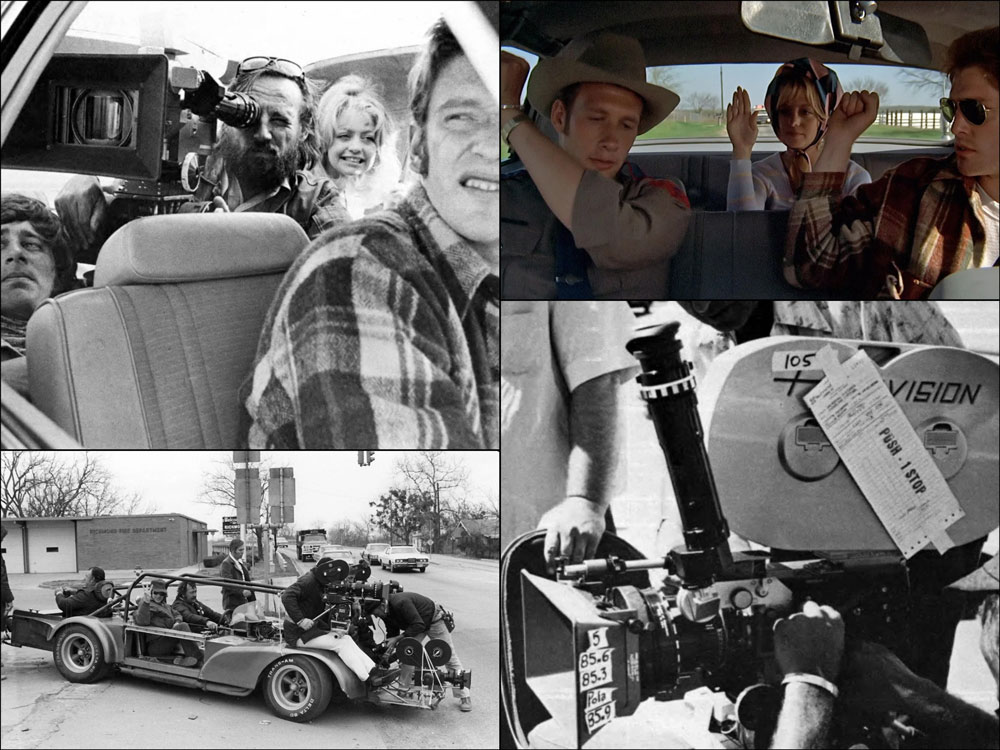
The significance of this shot extended far beyond its immediate technical achievement. By enabling a full, uninterrupted in-car perspective, The Sugarland Express demonstrated that new camera technology could fundamentally change storytelling possibilities.
Spielberg and Zsigmond’s work allowed filmmakers to maintain emotional clarity while navigating complex physical space, paving the way for more dynamic, immersive sequences in both action and drama films.
The Panaflex’s ability to capture synchronised dialogue on the move created opportunities for directors to experiment with real-time narrative and spatial continuity in ways that had previously been constrained by technical limitations.
Spielberg would carry this experience forward into Jaws, where shooting on open water presented a host of challenges. The Panaflex camera’s portability and quiet operation proved invaluable on the ocean, where heavy studio cameras would have been impractical.
It allowed Spielberg and cinematographer Bill Butler to capture fluid tracking shots from moving boats and close-ups of actors reacting to the mechanical shark, all while preserving the authenticity of performance and dialogue.
Although additional specialised rigs were needed for large-scale and underwater sequences, the Panaflex’s role in enabling naturalistic, mobile cinematography was clear, and it directly reflected lessons learned during The Sugarland Express.
In retrospect, The Sugarland Express stands as a quiet yet revolutionary moment in film history. Its in-car tracking shot, made possible by the Panaflex, is more than a technical milestone; it represents a creative leap in how filmmakers can merge technology and storytelling.
Discover more on Top 10 Films
Haunted Heroines: Brooke Adams’s Cinema Of Fear
Brooke Adams in Invasion of the Body Snatchers (1978)
From Body Snatchers to The Dead Zone, Brooke Adams’s haunted heroines reveal how fear, vulnerability, and quiet strength define her enduring screen legacy.
10 Essential Steven Spielberg Movies, Ranked

We check out 10 essential Steven Spielberg movies including Jaws, Close Encounters of the Third Kind, Saving Private Ryan and Jurassic Park.









Comments