
 By
By 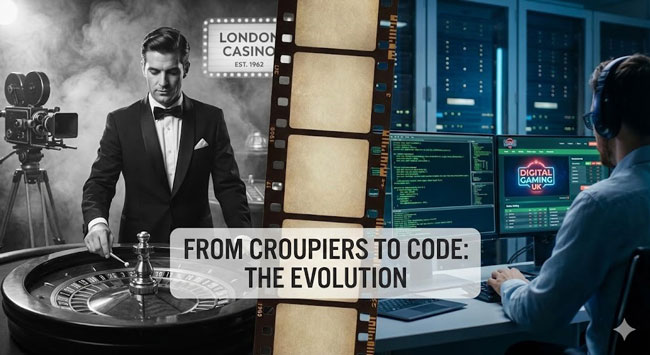
The image of gambling in British cinema is a deep, culturally significant indicator of the changing socio-economic situation, the psychological fears, and the ethical paradigms of the United Kingdom throughout the last 70 years. Being a narrative tool, the aspect of wagering cannot be compared to anything regarding its power to reduce characters to their bare essences, reveal flaws, desires, and the naked mechanics of decision-making in times of extreme need.
From the gilded charm of post war London to the ugliness of post-industrialization in the North, and, lastly, into the bandwidth atomization of algorithmic solitude of the digital age, British filmmakers have employed gambling as an elegant prism through which to analyze the shifting British character. This article discusses that process, and how the physical croupier transforms into the invisible code through the use of the film.
The Historical and Legislative Foundations of British Betting
The way out to the cinematic gambler, initially, requires a look at the historical and legislative environment of the UK. One of the turning points was the 1960 Betting and Gaming Act. Before this, most of the gambling in the country was conducted in the dark, with operations confined to the back alleys and promoting organized crime.
The 1960 Act changed the industry, making betting shops and state-licensed casinos legal. This transformation gave filmmakers a now valid, highly visual playing ground. The movie casino of the 1960s was defined by elegance and power, where gambling was transformed into a sign of elite sophistication and not of a moral problem.
The Aristocratic Rake: James Bond and the Semiotics of Baccarat
No character portrays the original movie’s ideal of the British gambler like James Bond. Invented by Ian Fleming, Bond is a polite rake, an aristocrat who is a wit and whose mastery of the casino table is the metaphor of geopolitical brinkmanship.
The Iconic Introduction
The fact that Sean Connery is introduced to the viewer in the 1962 film, Dr. No, in a scene in Chemin de Fer table, Les Ambassadeurs Club, London. Bond is dressed in a specially designed tuxedo, and he simply assesses his cards, and that is a message to the audience that he is never out of place.
The Shift to Poker
The franchise staple was Baccarat, a game of pure chance, and its preserve of the European nobility. Nevertheless, the 2006 re-adaptation of Casino Royale marked the need to update it. Akin to the poker boom of the world, the movie substituted Baccarat with No Limit Texas Hold Em. This change compelled Bond to trust in the use of tells, heart rates, and mathematical probabilities, and to base the character on a more brutal, analytical reality.
Northern Noir: Industrial Decay and Gritty Realism
Whereas the Bond franchise suggested an upper-class dream, a radically different trend came out in the early seventies: Northern Noir. With the UK experiencing an increasing unemployment and the dynamics of different classes, filmmakers were looking into the grim realities of the working-class criminal underworld and the violence they were all about.
Get Carter: The Antithesis of Glamour
The masterpiece of Mike Hodges, Get Carter of 1971, removed the tuxedoed splendour of Mayfair. In this movie, gambling is the economic driving force of the rotting Newcastle. Jack Carter (Michael Caine) is a cold mob enforcer who is seeking the reason behind the death of his brother, who is walking around in a world where businessmen own low-rent slot machines and seaside arcades.
These villains are also unlike Bond, who is a suave guy; they are merely opportunists who prey on localized vice. The gambling scenes are cynical, smoke-filled, polluted areas that lack honor, which form a society where the working class is an exploited class.
Neo-Noir Deconstruction: The View from the Pit in Croupier
If Get Carter revealed the brutality of the criminal economy, the film Croupier by Mike Hodges in 1998 was an operation that removed the veneers of the legal casino business. The movie, which features Clive Owen as Jack Manfred, a struggling writer who works as a dealer, is a viewpoint of the pit.
The Ethics of Humiliation
The monologue in the mind of Jack can give the audience a glimpse into the ethics of humiliation that runs the house. Croupier breaks down the essence of gambling, which is premised on irrational wishes and the mathematical illiteracy of patrons, and requires the employees to pose as incorruptible moral figures.
The well-known observation, made in the film, of how gambling is not about gambling, makes it clear that the casino is the most powerful tool, as it is dependent on the law of large numbers and not on luck. In this case, the gambler is reestablished as a hero into an alienated spectator benefiting from human defeat.
The Charismatic Rogue and the Democratization of the Hustle
Director Guy Ritchie, at the same time as Croupier, reinvigorated the British crime genre. The movies such as Lock, Stock and Two Smoking Barrels (1998) and Snatch (2000) made the so-called Charismatic Rogue famous.
The Underclass Hustle
Gambling in the world of Ritchie is dragged out of the controlled casino and into shabby pubs and bootleg boxing rings. The editing is hyper-kinetic, and the imagery is more MTV to get the adrenaline rush of the underworld hustle. Although there is physical violence in the enforcement of the debts, the stories glorify the resourcefulness of the everyman trying to outwit a faulty system.
Television Drama and the Compulsive Reality
Although gambling is often the means of generating thrills in a movie, British television drama has explored the devastating truth of addiction.
Social Realism in Broken
The 2017 drama Broken by Jimmy McGovern is a scathing critique of Fixed Odds Betting Terminals (FOBTs). With its setting in a poor northern parish, the series charts the progression of a mother who undergoes a crippling addiction and ends up embezzling thousands of pounds.
Through this play, McGovern reveals the area in which the industry is targeting the needy communities. The gambling machine is not depicted as a glamorous gamble, but as a predatory, computer-generated addiction aimed at draining the very last capital out of the weak.
The Digital Paradigm: From Physical Chips to Invisible Code
The technological transition to the digital world is manifested in the most dramatic development of the film image of gambling. The social friction of the traditional casino is eliminated by the internet revolution and the ubiquitous smartphones.
Frictionless Access
There is now 24/7 access to wagering through mobile applications. This is changing face-to-face communication to online solitude with significant psychological consequences. Contemporary gambling is based on the concept of variable ratio reinforcement, in which the uncertainty holds the user in a hypnotic cycle.
Online Slots and the Architecture of Modern Risk
In modern realities, the main character can be easily located alone, playing the dopamine-stimulating sound effects of the online slot machines. Such digital platforms operate with the use of a near-miss animation and game-like interface to trigger a state of flow in the user that does not keep the user aware of time and financial reality.
The digital gambling experience is atomized as compared to the communal nature of the Bond-era casino. It is not about a physical opponent, reading over a mahogany table anymore; it is a psychological struggle within oneself, with an unknown algorithm.
The Evolution of Visual Storytelling
The shift of the physical casinos to digital platforms has required a reevaluation of cinematic visual language. Directors have to sell high stakes without the classical iconography of a spinning roulette wheel.
Comparative Visual Language
| Cinematic Element | Traditional Casino Cinema | Digital/Modern Gambling Cinema |
| Lighting | Film noir shadows, warm chandeliers. | Harsh blue light from smartphone screens. |
| Framing | Wide shots of luxury; focus on physical tells. | Extreme close-ups of retinas reflecting interfaces. |
| Soundscape | Clinking chips, ambient background jazz. | Synthetic digital pings, pulsing electronics. |
| Narrative Focus | Interpersonal psychological warfare. | Internal compulsive addiction loops. |
In order to see the strains of a digital wager, screen reflections and cold lights have been applied by directors to emphasize how a character is disconnected from the real world.
The Converging Feedback Loop
Interestingly, as the cinema tries to depict the truth of the digital screen, the language of cinema has been borrowed by the iGaming industry. The current destination of online slots and live-dealer services incorporates complicated plot progressions, an authorized orchestral musical score, and a film-noir overlay to heighten customer retention. This has led to a reflexive loop wherein the digital platforms are pretending to be the grandeur of film to keep the users entertained, whereas the film tries to capture the loneliness of the disconnect that digital platforms bring.
Conclusion: The Endless Wager
Gambling development in the British film industry offers a complex commentary on the course of society. The casino, in the aftermath of the war, became a platform of domestic hopes of prosperity and imperial pride. By the 1970s, it turned into a reflection of the industrial blight and the struggle of the classes. In the modern world, it is a sign of a technological addiction that does not depend on geographical location.
The protagonist will be dressed in a tuxedo at Mayfair or staring at a blank screen at the online slots in a dark room, but the fundamental narrative role will be the same. Gambling remains the final existentialist test: a filmic trial that compels characters to analyze their most inherent weaknesses and the inability to predict the fortunes of fate itself.














Comments