
 By
By 
New to Alfred Hitchcock?
Well, if you’re eager to check out some of the great British filmmaker’s best work beyond his most notable film Psycho, then keep reading.
For many, the black and white suspense-thriller about Norman Bates and his infamous motel, is the Hitchcock film they know and love. But his other work is equally compelling.
In fact, Psycho is hardly Hitchcock’s best film. That title goes to either Rear Window or Vertigo, depending on who you talk to.
What Hitchcock films should I watch?
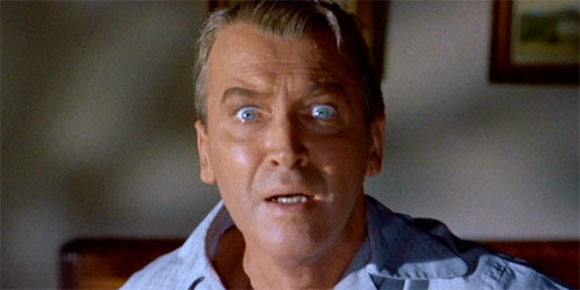
James Stewart in Alfred Hitchcock’s Vertigo.
Perhaps best known for Psycho, Hitchcock’s trademarks – voyeurism, suspense, and the wronged man/woman – can be seen in films stretching across a career that began in the 1920s, took off in 1935 with The 39 Steps, and wouldn’t end until Family Plot in 1976.
His body of work is truly astonishing and not matched by anyone. It does mean there are plenty of gems to enjoy after Psycho’s credits have rolled.
North By Northwest
(1959)

Pauline Kael proclaims on the DVD cover that North By Northwest is “one of Hitchcock’s most entertaining American thrillers.” If Hitchcock made a James Bond movie it would be something like this.
North By Northwest, along with Psycho and The Birds, is probably one of the most widely seen of the great master’s films. It’s certainly one of his most accessible and a great introduction to the director’s work.
Cary Grant is Roger Thornhill, the wronged man caught in an ever-tightening web of intrigue, corruption and murder. He’s tracked across America by enemy agents, government officials, and the police. They want him only he doesn’t know why.
Fleeing for his life and his sanity, Thornhill dodges bullets and even planes as he tries to stay alive. It’s fast-paced and energetic, frequently funny thanks to Grant’s perfect comic timing, and, of course romantic, with Eva Marie Saint appearing as the protagonist’s muse.
Hitchcock also loved sexual innuendo and there was no one better to implement such a gag than Cary Grant. The film concludes with one of the great cuts and final shots of any of Hitchcock’s films.
Grant, clinging to the edge of Mount Rushmore, tells Eva Marie Saint, who is hanging on to a ledge, to reach for his hand. She cries out that she can’t do it but he reassures her. As their hands finally meet, Hitchcock cuts from the cliff edge to a train compartment where Grant lifts Saint on to the bed. They begin to kiss and Hitchcock concludes by cutting away to an exterior shot of the train entering a tunnel.
Lifeboat
(1944)

Hitchcock could do grandiose – the sumptuous San Francisco locations of Vertigo and cross-country action-adventure of North By Northwest, but he could also do intimate, character pieces that used minimalist theatre staging as in Dial M For Murder and Rope.
Lifeboat sees the director utilise a single location to tell the tale of several survivors after a World War II U-boat attack in the North Atlantic. Those aboard pull together to help each other through the trauma but it isn’t long before they pick up another survivor – the German U-boat captain who sank their ship. Should they give him shelter or throw him back into the sea? The dilemma threatens the harmony of the lifeboat.
This 1944 film was made before the end of the Second World War and was as much a celebration of British bravery and the humane nature of the allied forces in the face of battle, as it was an indication of the technical mastery of its director.
Hitchcock had been making a lot of melodramas in the UK and wanted a change. Lifeboat, from a story written by John Steinbeck, gave him that opportunity, showcasing his technical skill within the constraints of the stage: a boat drifting in the ocean.
Shadow Of A Doubt
(1943)

Before Vertigo was re-evaluated and became known as the best Hitchcock movie amongst the critical elite, Shadow of a Doubt was considered the director’s best film. That was a sentiment shared by the director himself who viewed it as his greatest achievement artistically.
Less flashy than Hitchcock’s later American films, Shadow of a Doubt has more in common with the slow-burning tension of Psycho than it does with the technical ingenuity of Rear Window or the action-adventurism of North By Northwest.
It is more a character study focusing on a young girl named Charlie and her uncle, also named Charlie. Teresa Wright, who plays the girl, is thrilled when her uncle comes to stay with the family, but her glowing admiration of the man turns sour when she begins to suspect he is the Merry Widow Murderer – a serial killer on the run from police.
When the uncle (played with particular aplomb by Joseph Cotton) learns of his niece’s suspicions he decides he must plot her own demise in order to protect his interests.
A heightened level of tension resulting from the unique dynamic between two characters who initially have great affection for one another, makes for one of Hitchcock’s most interesting and rewarding films.
Dial M For Murder
(1955)
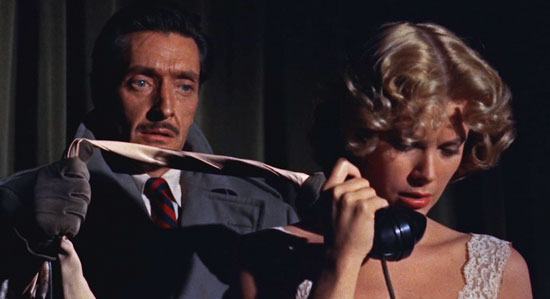
Frederick Knott wrote the original play that formed the basis for Dial M For Murder. It was written in the early 1950s, debuted as a BBC television play, and then had stints on London’s West End and New York’s Broadway.
Several years later Knott would write his only other successful play – another single location thriller called Wait Until Dark starring Audrey Hepburn. Both films are supreme examples of well-crafted, brilliantly characterised suspense stories.
They feature Knott’s favoured trait of an innocent woman trapped in a seemingly lawless situation. They are also based almost exclusively in the apartment of the victim.
Dial M For Murder is a great example of simplicity at its most enthralling and suspenseful. It’s delivered with style and controlled elegance by Hitchcock. He weaves a dramatic tale with its incendiary moment being Tony Wendice (Ray Milland) realising his watch has stopped and he’s late making the call to his contract killer. That means his plan to kill his wife is almost certainly botched.
It’s a sequence of high tension, beautifully edited together to show the three characters’ unpredictable situations. Running as a constant throughout is innocent Grace Kelly and the will-she-won’t-she predicament of her impending murder.
Rope
(1948)
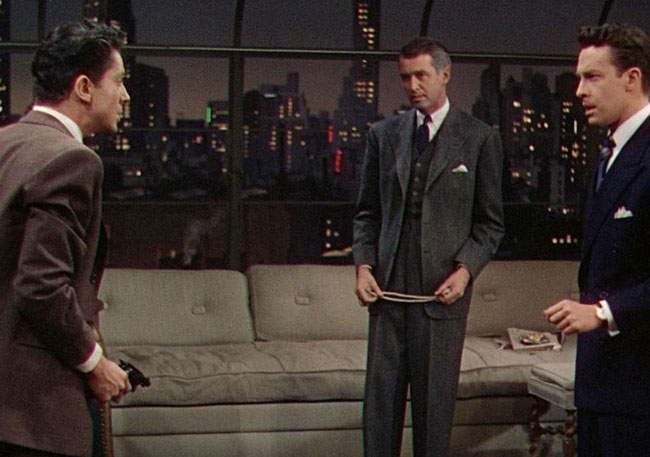
Rope presented Hitchcock with a unique opportunity to show audiences something they hadn’t seen before while testing his own skill with the camera. Shot in a single location with reel-long takes (approximately 11 minutes), Hitchcock pieced the film together in a way that made it appear as a completely unedited film.
In many ways Rope shares similarities with the stage – the actors having to get their lines right first time around, and the location remaining in one place. When you consider that it had never been attempted before and the fact the cameras in the 1940s were huge, bulky, heavy contraptions that required several people to move, Rope is an even greater technical achievement.
The film follows the aftermath of a murder. Two friends played by Farley Granger and John Dall, hide the body in a trunk they use as a buffet table. They then invite acquaintances of the dead man, including intellectual James Stewart, to the apartment to show off their skills to carry out and cover up the perfect murder.
It’s a sadistic film but blackly comic. It also deserves credit for its edgy look at relationships with references to the murderers’ sexuality. Hitchcock cleverly weaved this into the story to avoid censorship. With writers Hume Cronyn and Arthur Laurents, references to a possible gay relationship between Granger and Dall are subtle. There is only one bedroom in the apartment the two men share, for instance.
Notorious
(1946)

David O. Selznick was instrumental in bringing Hitchcock to America and helping him establish a career in Hollywood. However, Notorious was the film where Hitchcock realised Selznick was actually compromising his genius.
Selznick had previously brought Hitchcock together with writer Ben Hecht and star Ingrid Berman for the psycho-drama Spellbound in 1945. Selznick assembled the same group for Notorious but Hitchcock managed to keep the powerful producer at arms length, finding the creative process, and the eventual final product, much more satisfying.
Notorious is one of Hitchcock’s earlier American movies but the traits that would signify his films during his golden Hollywood period are there for all to see – the beautiful female lead, the romantic sub-plot, espionage and political intrigue, and of course brilliant use of the camera.
Cary Grant recruits Bergman at the end of the Second World War to infiltrate a group of Nazi exiles in Argentina. The woman, under the strain of Grant’s clinical spy, marries Claude Rains’ Nazi but has a romantic attachment to Grant.
Hitchcock turns the tension up when Grant is forced to save Bergman from this group before they discover she is working for US intelligence. Interestingly, the film featured the longest on-screen kiss at the time it was made. Another example of Hitchcock’s ability to push the boundaries of the medium and do things others hadn’t attempted before.
Check out more great Alfred Hitchcock films here.








Comments