
 By
By Siobhan Finneran’s vacant stares into space and blank, emotionless expressions speak volumes in Daniel Kokotajlo’s compelling drama, Apostasy. That it’s the writer-director’s debut feature film is almost as astonishing as how much Finneran is able to convey wordlessly. It is almost as if she has had life sapped from her body only for her brain to engage her voice from time to time – like a robot flicking the “on” switch – to reel off another line from the New World Translation of the Holy Scriptures or recall the duties of “the truth”.
She is, as Ivanna, the matriarch of a devout Jehovah’s Witness family. Her grown-up daughters have been indoctrinated into their mother’s belief system and follow it to the letter. But Alex (Molly Wright), who recently turned 18, possesses guilt for having a life-saving blood transfusion as a baby (a sin in the eyes of her elders) while twenty-something Luisa (Sacha Parkinson) is increasingly concerned about the constrains of her faith on the conventional normalities of modern life.
Kokotajlo based the film on his own experiences as a Jehovah’s Witness. Memories that – at least as far as Apostasy is concerned – are far from fond. The film, which takes its title from a word meaning the abandonment or renunciation of a religious belief, isn’t prepared to sit on the fence. Without the placard-waving profanity of the infamous Westboro Baptist Church, it’s convenient to dismiss Kokotajlo’s congregation as benign. But it’s anything but.
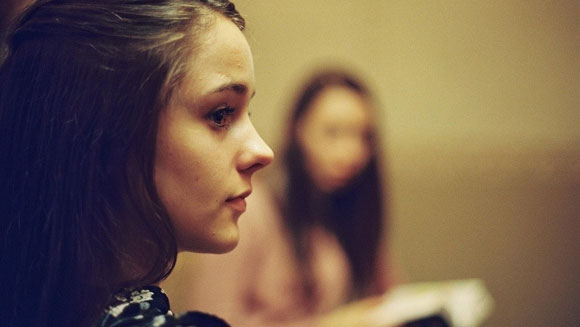
And that’s immediately apparent. Intimately framed in Academy ratio we learn Alex is willing to put her life at risk for her faith, refusing a blood transfusion in the event her anemia causes her to be hospitalised again. Removed from the doctrine instructing her decision, the hardened atheist can’t help but find it astonishing. Her own mother is not only in agreement but enforcing it, not as obscure, cruel alternative but common sense.
It’s the tragedy that smothers Apostasy. And it’s what makes it such a captivating piece of familial angst in the face of religious servitude; loyalty, guilt, trust and faith erupting to the distant sounds of scripture and the alarm bells of the impending Armageddon.
Kokotajlo succeeds in evoking crushing poignancy with a soft-handedness that acknowledges the beats of silence in his script and the talents of his cast to emote without a convenient line of dialogue. His stylistic decision to offset the momentum of some of Alex’s scenes through inner monologue being voiced as if to someone offscreen, is an astute distraction. This is a young woman tightly gripped to her faith by a rope she refuses to let go of. But the rope is fraying; she craves it’ll unexpectedly break.

Like another brilliant familial drama centred around a young woman – Andrea Arnold’s Fish Tank – Kokotajlo’s use of the squarer Academy ratio is an ideal way to focus our attentions on personal conflict. It perhaps also puts further onus on the performances; indeed, Finneran, Wright and Parkinson all have their fair share of wordless close-up and each excels. And although Apostasy is ultimately damning in its critique of religious fundamentalism and the irrefutable principles of biblical scripture, it shrewdly leaves all its preaching to the elder at the lectern.

 Directed by: Daniel Kokotajlo













Comments