
 By
By Despite its age, a scathing indictment of racism in contemporary America made by one of Hollywood’s true auteurs almost five decades ago remains relevantly potent. Mark Fraser looks at an early 1970s guerrilla project that time has failed to erode.
Back in 1991 – while analysing Brian De Palma’s credentials as a political filmmaker – US-born critic Armond White lauded the director’s 1970 satiric movie Hi, Mom!, saying it was a work “that could only be made outside of the system”.
Furthermore, he argued, no mainstream release had since “said more about race and media”, simultaneously exploding racial stereotypes and “the conventions of TV/film perception”.
“Rated X and little seen at the time, Hi, Mom! holds up remarkably well in the age of sex, lies and videotape,” White wrote in Film Comment.
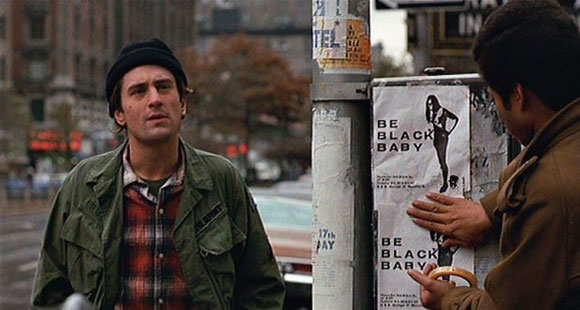
“De Palma’s tale of peep-art voyeur/revolutionary (Robert De Niro doing a rough draft of Travis Bickle’s anomie) seems absolutely prescient about the pervasive private uses of media and the concomitant isolation of the sexes and races. The Be Black Baby sequence, in which the pieties of public television are satirised, then vilified, is simply one of the great moments in American movies.”
Some 28 years later this observation remains absolutely valid – particularly the praise for the extended Be Black Baby episode, a harrowing piece of produced-for-TV black and white cinema verite which dominates the middle third of the film and represents one of De Palma’s finest screen moments.
Given the director’s vast body of work, this may sound like a bold (and possibly unbelievable) piece of overstatement. But it’s an undeniable fact that this movie-within-a-movie is still a disturbingly potent comment about race relations in America and shows the director at his most courageous.
Moreover, it is also quite terrifying – much in the same sort of distressing way as the not-totally-dissimilar 1992 Belgian masterpiece mockumentary Man Bites Dog, despite the fact there are undeniably some stark differences between these two works.
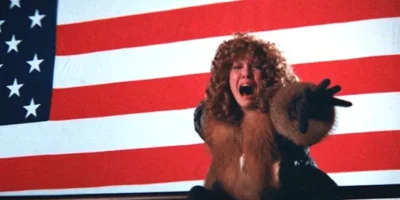
In Be Black Baby (as opposed to the rest of Hi, Mom!) De Palma pretty much eschews humour, exposing instead a seething anger which reaches one of its boiling points when a group of middle class Caucasian off Broadway theatre-goers in Greenwich Village are intimidated, victimised, and then physically assaulted, by a group of radicalised African American actors intent on letting whitey know about the contemporary Negro experience in the US.
The cast force members of its small audience to eat soul food, smear their faces with black shoe polish, steal their belongings and verbally browbeat them before one of them starts raping a female patron.
A white policeman (played by an intensely hilarious De Niro, who is also a part of the troupe) then arrives and begins meting out his version of tough justice on the cowering and sobbing “black” crowd.
As with Man Bites Dog – the one hit wonder brainchild of Remy Belvaux, Andre Bonzel and Benoit Poelvoorde which is also an exercise in extended black and white cinema verite – what starts out as a dark joke becomes horrifying; suddenly the viewer is faced with an imminently life threatening situation, and it’s at this point the panic really starts to set in.
Extended treatise
This theatre performance, though, is just the first part of De Palma’s (and his co-writer Charles Hirsch’s) attempt to, in White’s words, warn about the complexity of ideology and expose so-called objective points of view as a matter of hegemony.
And in order to appreciate this political polemic, one really needs to accept Hi, Mom! and its strangely informal narrative structure at face value.
Essentially a sequel to De Palma’s 1968 movie “Greetings”, the story follows the adventures of Jon Rubin (De Niro) after his return to New York following a stint in Vietnam where (as seen at the end of the first movie) he is able to freely follow his voyeuristic desires by coercing a Viet Cong woman to undress for a television camera.
Rubin rents a rundown apartment in the village so he can clandestinely film the people living in the building across the street as part of his peep art project. Two of them, it turns out, are behind the production of the Be Black Baby show.
When his attempt to capture himself having sex with one of the tenants (Judy Bishop, played by Jennifer Salt) fails, though, he loses the confidence of his backer Joe Banner (Alan Garfield)* and, with nothing to lose, decides to try out for the stage show as the policeman.
As all of this is going on, the Be Black Baby movement is making a television program of its own (for the National Intelligent Television, or NIT, network), with the footage starting out as a series of vox pops interviews before morphing into Hi, Mom!’s second big monochrome verite pieces, that being when a group of Black Panther lookalikes storm an apartment building – an act of terrorism that ends in machine gun violence and death.
While not as oddly personal and intimidating as the off Broadway stage show, this accompanying set piece is nevertheless handled with alarming deftness by De Palma and his cameraman Robert Elfstrom, who create a violent and angry narrative for the TV screen that any docu/mocumentary film maker would be proud of.
Eventually, when Rubin recognises this propaganda for what it is, he becomes disillusioned with the cause which he briefly thought he was part of and decides to become an urban guerrilla – a lone wolf terrorist who, like returned Vietnam veteran Bickle in Martin Scorsese’s Taxi Driver (1975), morphs into an anarchist with a murky cause.
Subversive cinema
Although Hi, Mom! is arguably at its best when engaged with its multi-faceted discourse on racism and media manipulation, the rest of the film is by no means uninteresting.
Rubin’s satiric transformation from wannabe pornographer to (presumably) mass murderer via radicalisation through a Black Panthers-type movement may not be completely convincing, but it does have its moments, and is certainly compelling enough to help carry the movie’s sometimes lofty ambitions.
In this regard, De Niro’s versatile acting chops are clearly on display. Rubin’s seduction of Bishop, for instance, is laced with a good natured charm that is both refreshing and genuinely funny, despite the fact his overall agenda is based on deceit.
And when he becomes the policeman in Be Black Baby, this façade quickly dissolves into one of aggression and intensity that is genuinely harrowing.
Meanwhile, his descent into urban disillusionment post his brief artistic stint is dominated by the same kind of scuzziness which plagues Bickle throughout most of the landmark Scorsese picture. If anything, this could well be De Niro’s first truly great, albeit understated, roles.
Then there’s De Palma, a film maker who can be as annoying as he is brilliant – a true auteur who was obviously influenced by European cinema of the 1960s in his early days, but eventually, at a superficial level at least, chose to spend a good deal of his career putting critics offside by wallowing in Hollywood excesses.
What’s interesting about White’s above-mentioned comments – which were written just as The Bonfire of the Vanities (1991), a movie regarded by many as one of the director’s most lavish failures, was hitting the screens – is that he doesn’t regard the man’s work as a cop out.
“Since (Hi, Mom!) … no mainstream movie has said more about race and media (Atom Egoyan, be gone),” he writes. “De Palma’s subsequent adventures in the screen trade were experiments in narrative that conducted his youthful rebellion and didacticism into more commercial forms.”
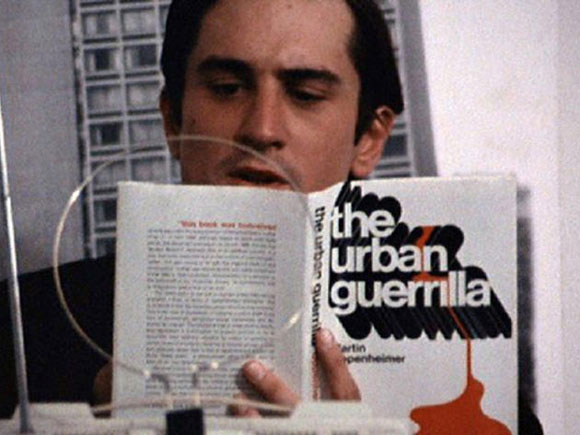
This point is more or less reiterated by American critic and film maker Howard Berger who, in one of the extras included in the Arrow Blu-ray edition of De Niro and De Palma – The Early Years, suggests that by including a scene in the movie when Rubin reads out aloud a passage from Martin Oppenheimer’s 1969 book The Urban Guerrilla, the director is “basically stating to the audience that he is a cinematic terrorist” who will “assimilate into society as a respectable mainstream director” before levelling it “in the most subversive way possible” – a campaign he eventually launched in earnest following the release of Sisters in 1973.
“And that’s consistent from the beginning of his career,” Berger says.
“He is one of the few directors that I can actually say I hesitate to judge critically any one film he has made because they all contribute so strongly to a cinematic world view.”
Hi, Mom! – and in particular its brilliant Be Black Baby sequence – is a testament to this.
FOOTNOTE
*Garfield appears as a porn peddler who sells Rubin a dirty movie in “Greetings”, of which Hi, Mom! is the sequel. In the second instalment, though, they don’t seem to have known each other before they meet. On that note, Rutanya Alda appears in both movies, but it is not made clear if she is playing the same character.
BIBLIOGRAPHY
Armond White: “Brian De Palma, Political Filmmaker”, Film Comment, May-June 1991 (Film Society of Lincoln Centre, New York) pp 72-78
Words by Mark Fraser
Discover more writing on film by Mark Fraser
“Man With A Movie Camera” Transcends Propaganda | “The Deer Hunter” Remains An Adult Fairy Tale | “The Train” Still One Hell Of A Ride | “Barry McKenzie Holds His Own” Maintains Its Irreverent Grip | Umberto Lenzi’s “Eaten Alive” Is A Hard Act To Swallow | William Friedkin’s “Sorcerer” Is A Curiously Mistreated Masterpiece | “To Catch A Thief” Shows Hitchcock Dabbling In Blandness
Hi Mom was released in the UK as part of the De Niro & De Palma: The Early Years box set from Arrow.







Comments