
 By
By 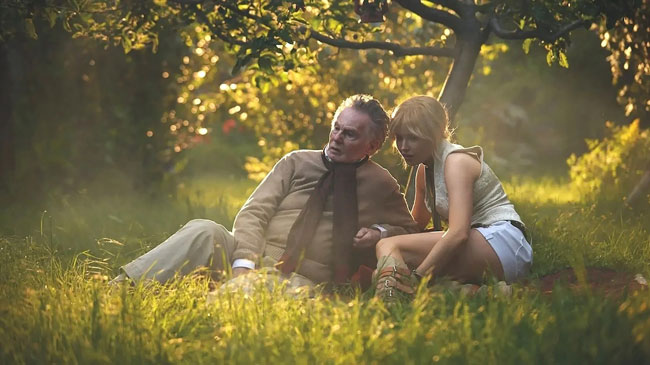
Following its highly anticipated premiere at the BFI London Film Festival and its recent rollout across UK cinemas, Moss & Freud has quickly established itself as one of the most intimate biographical dramas of the year.
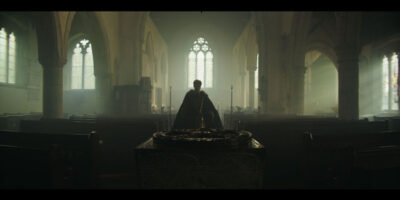
Written and directed by Academy Award winner James Lucas, the film pulls back the curtain on the unexpected, deeply protective friendship that formed between supermodel Kate Moss (played by Ellie Bamber) and legendary painter Lucian Freud (Sir Derek Jacobi) during their famous 2002 portrait sessions.
Set against the backdrop of a heady, bohemian London scene that Lucas himself witnessed firsthand, the film explores the vulnerable friction between high fashion, fine art, and the exhausting burden of public persona.
In Top 10 Films’ exclusive interview, Lucas speaks to Dan Stephens about how he transformed this real-life clash of cultural titans into a deeply personal, semi-autobiographical piece of cinema.
From collaborating directly with Moss to ensure the script’s raw authenticity to channelling the meticulous, detail-oriented filmmaking philosophy he learned under Ridley Scott, Lucas shares what it took to capture the “kindred spirit” dynamic of his subjects. He dives into his creative process, the “uncanny” gravitas that Jacobi brought to the canvas, and how the production ultimately unmasked the emotional truths of two of Britain’s most enigmatic icons.
Top 10 Films: What first pulled you toward the story of Kate Moss and Lucian Freud, and why did this particular moment in their lives feel like the right canvas for your next film?
James Lucas: I remember it happening at the time, when I was, myself, a grommet on the frontline of the heady London art/fashion/film/party scenes. I always wondered what these titans of culture talked about during and around the sessions. I was curious.
I feel all paths led me to tell this film story; the topography, emotional and psychological drama, bohemianism, beauty, characters and artistic process. In a strange way the movie is also semi-autobiographical – I relate to the characters and I relate to the time and place.
T10F: When adapting a real relationship as intimate and unusual as theirs, what were your ambitions in shaping the truth into what we see on screen? What emotional or thematic truths were most important for you to preserve?
JL: This is ultimately a story about truth – an exploration of the surface and the inner self. Lucian was very good at unearthing an individual’s truth and that’s what we find in this movie. Kate’s truth and Lucian’s truth. It’s a brave move for Kate, to reveal to an audience her persona, vulnerabilities, flaws and wicked sense of humour. Perhaps an audience will not only be entertained by her charisma but also recognise some of their own humanity in her.
I deal in authenticity. Through my discussions with Kate and Lucian’s former assistant, David Dawson, alongside deep research, I’m convinced I’ve captured their true personalities.
T10F: Can you talk us through your research process? What sources, interviews, or archival material proved most revealing as you pieced together the dynamic between Moss and Freud?
JL: I read everything and anything I could on these two incredible people and, yes, reviewed any interviews and footage I could find and even use the interview format within the movie. But, the most important source, by far, were the primary sources of Kate Moss, Bella Freud and David Dawson. I could not have made this movie without their insight and honesty. For that I’m eternally grateful and respectful.
T10F: Did anything unexpected emerge during your research such as details about their friendship, their personalities, or the portrait sessions, and did these reshape your understanding of the story you wanted to tell?
JL: The more I delved, the more I understood what a momentous moment in time and space this was for both Kate and Lucian. A formative period of transformation and creation. I suppose once inside the two characters I understood the incongruity was more surface and, actually, they were kindred spirits of a sort. As Johnny Cash sings in the soundtrack, ‘It takes on to know me’…
T10F: Was Kate Moss involved in the development of the film in any way, and did her perspective influence how you approached her portrayal on screen?
JL: Kate was involved from the very beginning. Again, I’m so grateful to her for trusting in my filmmaking and choosing this movie to articulate how the ‘real’ Kate looks and sounds and thinks – magically portrayed by Ellie Bamber. Every iteration of the script was passed by Kate, who very quickly let me know if something was right or wrong. She became an Executive Producer, as a way of showing esteemed gratitude, and as a way of ensuring authenticity.
T10F: You wrote and directed the film — was juggling both roles a challenge, or did the dual responsibility feel liberating in shaping such a personal, character driven story?
JL: I think I have undiagnosed Hyperphantasia – my life has been one long movie! [laughs] So, when I’m approaching a story with interest I’m really experiencing it in a 360 degree, panoramic way. In a way, I could see both characters’ personalities and then use a process akin to defragmentation, to build a sort of empathetic model of them. I suppose it’s not unlike the process an artist like Lucian may use to reveal his subjects’ truth and soul.
I enjoy this process and I enjoy writing it down, accordingly. If I can’t walk the walk, I can’t talk the talk… And I think I owe it to an audience to entertain and inform them faithfully and to the best of my ability.
T10F: Derek Jacobi brings enormous gravitas to Lucian Freud. What was it like collaborating with him, and what qualities did he bring that helped define your interpretation of Freud?
JL: Derek is a man to be cherished and admired. One of the greatest actors ever, talent-spotted by Laurence Olivier. I got on with him famously, I was in awe of his craft and career. I learnt so much from him and I will never, ever forget how lucky I have been to have worked with him. We spoke in great detail about Lucian, Derek absolutely knew what he was doing and his portrayal is uncanny.
T10F: What stood out about Ellie Bamber when casting her as Moss, and how did your formative years at Ridley Scott’s RSA Films — your “masters in film” — shape the way you approached directing both her and the film as a whole?
JL: Ellie was an incredible asset. I honestly don’t know if this movie could have been made without her or Derek. Ellie has more than a passing resemblance to Kate (more so with hair and make up et al) but, when I met her, what struck me was her similarity to Kate in terms of being this bold, ambitious young woman, imbued with natural intelligence and a type of street smarts that have allowed her to safely navigate the sometimes sharky waters of media and entertainment.
Ridley once said “the devil is in the details” and this is true. I needed Ellie to be as prepared as humanly possible for this role. So we spoke at length about the role, Kate and the film story. We engaged a team around her for dialect, movement, physique and acting craft. She stepped up to the plate – at times when I was looking at the monitor, on set, I couldn’t distinguish whether it was Ellie or Kate I was looking at.
MOSS & FREUD is in UK cinemas 29th May.
Discover more interviews on Top 10 Films
Interview: Daniel J. Phillips Explores Identity And Fear In “Diabolic”

Director Daniel J. Phillips discusses the making of Diabolic, from its FLDS‑inspired roots to powerful performances, practical effects and the film’s escalating psychological tension.












Comments