
 By
By 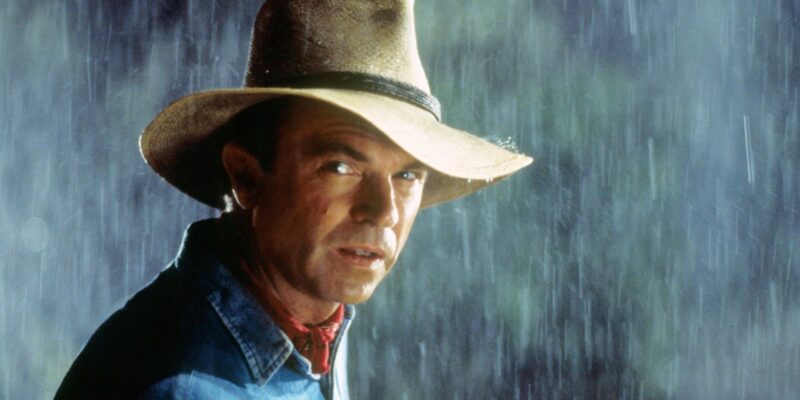
There’s no denying that Jurassic Park is one of the most loved films of the 1990s. Between John Williams’ soaring score, the groundbreaking VFX, and Steven Spielberg’s masterful tension, there is very little to criticise. However, if you poll the internet’s most eagle-eyed (or rather, eagle-eared) cinephiles, they will point to one specific, baffling anomaly: Dr. Alan Grant’s shifting voice.
In some scenes, Grant sounds like a grizzled boy from the American Midwest. In others, his vowels sharpen, and the melodic lilt of New Zealand rings through the Montana air. For years, fans assumed Sam Neill simply struggled to maintain his dialect under the pressure of outrunning a T. rex. As it turns out, the truth is far more chaotic. And it’s all Spielberg’s fault!
- 10 Essential Steven Spielberg Movies, Ranked
- “Duel”: Steven Spielberg’s Start As A Master Of Suspense
- 10 Reasons Jaws Might Be The Best Film Ever Made
The “actor’s nightmare”

Speaking with Vanity Fair, Neill finally cleared the air regarding his linguistic gymnastics. It wasn’t a lack of preparation that caused the slip-ups; in fact, Neill had spent a month meticulously crafting a standard American accent. He arrived on set ready to deliver a performance as American as apple pie, only for the legendary director to pull the rug out from under him during a pivotal moment of production.
According to Neill, the confusion began while filming the sequence where young Tim Murphy (Joseph Mazzello) is launched off a high-voltage fence.
“[Steven] came up to me halfway through the day and he said, ‘Hey, Sam, you know the accent we were talking about?’ I said, ‘Yeah, I’ve been working on it for four weeks…’ He said, ‘Don’t worry about it, just use your own voice.’”
For a brief moment, Neill felt a sense of relief. “I said, ‘That’s great, Steven, thank you so much.’” But the reprieve was short-lived. In a move that Neill describes as an “actor’s nightmare,” Spielberg changed his mind again just as Neill was settling into his native Kiwi cadence.
“Four days later, he came up to me and said, ‘You know that voice you’re using now?’ I said, ‘Yeah, my voice?’ He said, ‘Somewhere in between.’”
“A load of T. rex poo”
The result is the “trans-Atlantic-Pacific” hybrid heard in the final cut. Because the instructions changed mid-stream, Grant’s voice fluctuates depending on which day the scene was shot. Neill is the first to admit that the inconsistency is glaring.
“That’s why I get a lot of flak to this day,” Neill joked. “Sam Neill’s American accent in Jurassic Park was a load of T. rex poo.”
A legacy that roars

Despite the vocal hurdles, the film’s impact was — and remains — colossal. Long before it was a billion-dollar franchise, Jurassic Park was a high-stakes gamble. Universal Pictures backed Spielberg with $1.5 million just to acquire the rights to Michael Crichton’s novel before it was even published. While Spielberg was away in Poland filming Schindler’s List, he supervised a post-production phase that would change cinema forever.
The film didn’t just break box office records — becoming the highest-grossing film of all time until Titanic — it broke the digital ceiling. By combining Stan Winston’s life-sized animatronics with Industrial Light & Magic’s groundbreaking CGI, Spielberg created a turning point for modern visual effects. It even revolutionised how we hear movies; Spielberg invested in the creation of DTS (a new way to create surround sound in movies) specifically to showcase the film’s complex sound design.
Today, Jurassic Park isn’t just a movie; it’s a permanent fixture of our cultural history, preserved in the U.S. National Film Registry. Whether Alan Grant is speaking in a Kiwi lilt or a Montana drawl, the film’s ability to capture our collective imagination remains as powerful as a T. rex breakout. Some things, it seems, are simply “culturally, historically, and aesthetically significant” — accents and all.
Discover more on Top 10 Films:
Building A Giant: How The Sick Triceratops In “Jurassic Park” Became A Practical‑Effects Icon

The inside story of how Stan Winston Studio built and puppeteered Jurassic Park’s unforgettable sick Triceratops using pure mechanical movie magic.








Comments