
 By
By Not all old American combat movies wallow in chest beating bravado, as clearly shown by one released by Columbia Pictures in the first half of the 1940s. Mark Fraser looks at a truly pioneering work which never overstays its patriotic welcome.
Although Zoltan Korda’s 1943 World War II opus Sahara was made during a major global military conflict, it admirably refused to let itself be exploited as a shameless piece of Hollywood propaganda.
Not only that, but this well-scripted movie (written by Korda and John Howard Lawson, based on a 1927 novel by Philip MacDonald) ends up being quite an intelligently made battle yarn about a group of international soldiers which – with the help of an American M3 Lee tank named Lulubelle – makes a heroic against-all-odds stand against the Germans in the Libyan Desert as they try to retreat to El Alamein following the fall of Tobruk.
Leading this crew of stragglers, with a couple of POWs in tow, is Master Sergeant Joe Gunn (Humphrey Bogart), a tough, but fair leader who doggedly commands the makeshift outfit with pragmatic determination and egalitarian resolve.
Ably assisted by British medical officer Captain Jason Halliday (Richard Nugent), Gunn is forced to juggle the harsh desert sun, its twisting sands, limited ammunition, meagre rations, group dynamics and a quickly dwindling water supply as he guides his men through the most hostile of terrains while being pursued by a robust Nazi battalion.
Eventually, the group decides to stake some ground hosting a bombed out compound and dilapidated mudhole and meet the enemy head on – a somewhat foolhardy and desperate strategy, but one which nevertheless is bravely embraced by all of its individual members.
Thus the stage is set for a showdown that contains echoes of the second battle sequence in Steven Spielberg’s seminal 1998 war movie Saving Private Ryan, where a handful of men literally find themselves defying all expectations as they take on a fully armed German outfit to protect a small bridge.
Benign jingoism
While it’s undeniable American exceptionalism – in the form of Gunn and his fellow tank team members Waco Hoyt (Bruce Bennett) and Jimmy Doyle (Dan Duryea) – is clearly on display in Sahara, the film in no way beats its chest too loudly; nor does it attempt to overtly boost US morale, despite it being one of the key mechanisms that quietly binds the makeshift brigade and turns it into a formidable fighting unit.
Aside from Halliday, the troupe includes three other Englishmen (Carl Harbord, Patrick O’Moore and Lloyd Bridges), one South African (Guy Kingsford), a Frenchman (Louis T Mercier), a Sudanese officer (Rex Ingram) as well as two prisoners – a deceptive German fighter pilot (Kurt Kreuger) and a jittery Italian (J Carrol Naish).
Being from different parts of the world where English seems to be the universal language, the soldiers are able to communicate (and culturally connect) during a few dialogue-heavy moments, in which a broad range of subjects – including marriage, politics and even racial prejudice – are touched upon.
And, as is the case with most war movies with an ensemble cast, the characters who are eventually destined to die (which ends up being most of them) are picked off one by one, with each getting his own tailor-made death moment.
Furthermore, Korda and Larson also make an effort to look at the climatic battle from the enemy’s point of view via the efforts of the German commander Major Von Falken (John Wengraf) as he tries to negotiate some kind of truce as a means of accessing a perceived desert water supply. As a result, by the end of the conflict the fight has not really been motivated by ideological differences, but rather has been a battle by opposing sides to secure, through whatever means available, one of Earth’s essential natural resources.
Thanks to the strength of its intelligent and evenly-paced script, Sahara has aged remarkable well, which is no mean feat given it is over 80 years and was made at a time when other Hollywood films were prone to glorifying America’s pre-Normandy military efforts during World War II.
Given this, it could well be one of the first studio films from that era (it was produced by Columbia Pictures Corporation) which focused intimately on ground-based warfare against the Germans, with other US releases from around the time concentrating mainly on either conflicts with the Japanese, or European aviation sorties post the Battle of Britain.*
The fact it tries (albeit briefly) to humanise the enemy pretty much puts Korda’s movie in a league of its own, cementing its prominent place in the Second World War cinematic canon.
Sturdy performance
Finally, Bogart’s leading role in the movie should not be overlooked in any way, shape or form.
Aside from being both resourceful and decisive, Gunn also embodies a kind of heroic fatalism which ultimately underpins the group’s decision to stand tall in the face of overwhelming adversity.
It’s a remarkably controlled performance, with Bogart again playing a laconic thinker – as he famously did in Michael Curtiz’s Casablanca (1942) the year before – who fully understands the art of keeping one step ahead of the Germans.
FOOTNOTE
*Some examples of these are Paramount Pictures’ Wake Island (1942) as well as Warner Brothers’ Destination Tokyo and International Squadron, both of which, like Sahara, came out in 1943.
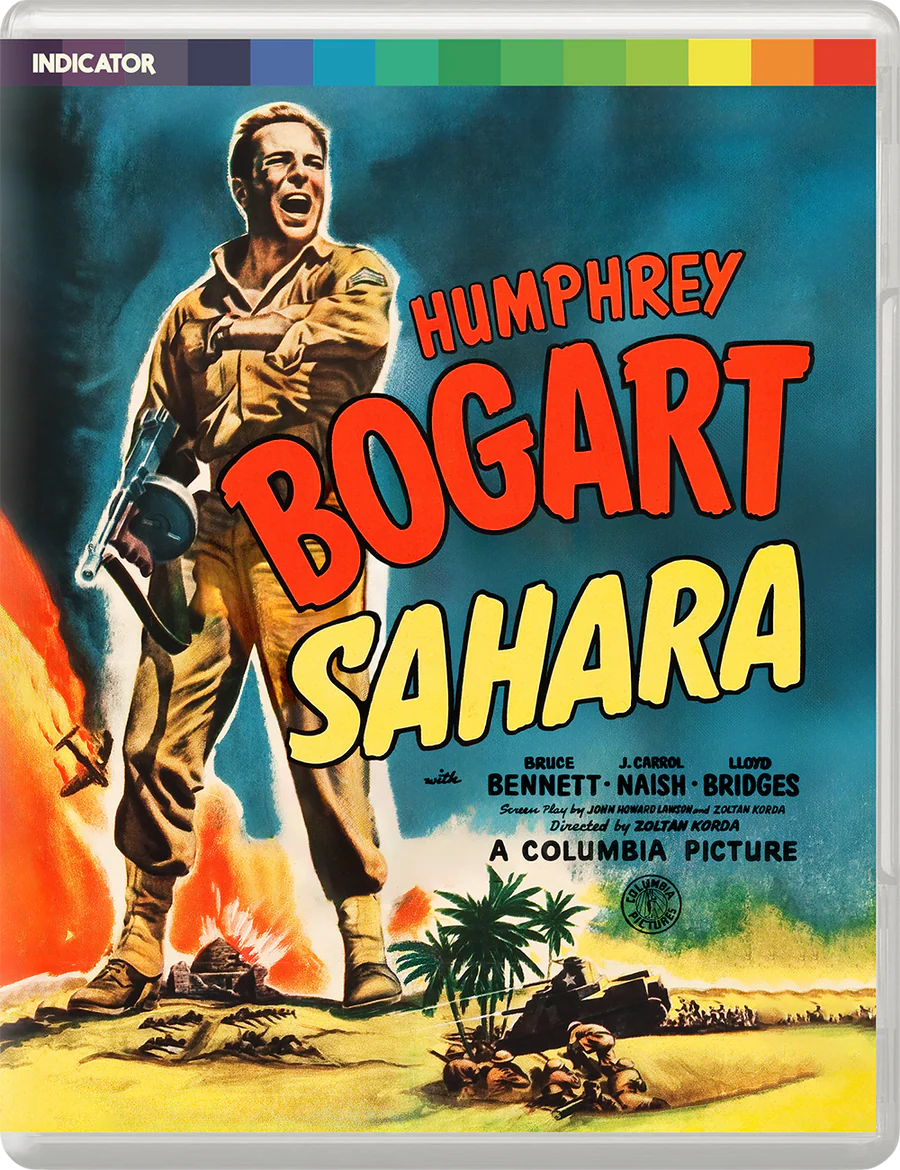
Sahara was released on Powerhouse Films’ Indicator series on January 20, 2025.
Discover more on Top 10 Films
10 Great Second World War Movies Made Outside America
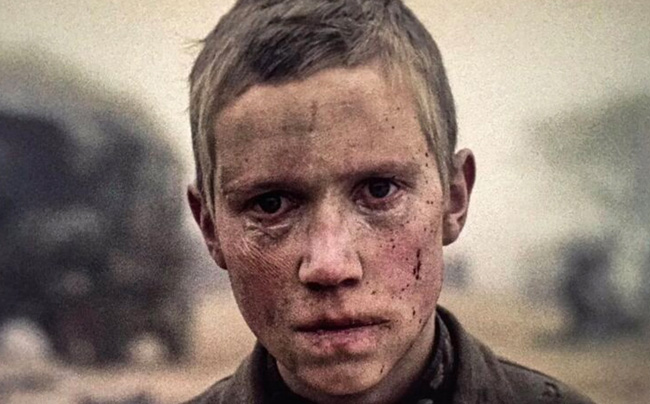
Come and See (1985)
From Soviet nightmares to German guilt and Italian hope, these WWII films made outside America reveal the true cost and complexity of war.








Comments