
 By
By 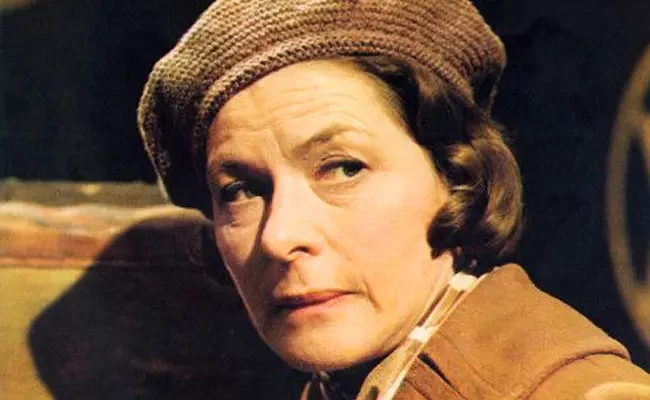
There really isn’t anyone quite like Ingrid Bergman. The Swedish-born screen legend enjoyed a career spanning decades, from Gregory Ratoff’s English-language remake of Intermezzo, the 1939 film that brought her to the attentions of American audiences, all the way through to 1978’s Autumn Sonata, her final film, in which she starred under the direction of fellow Swede Ingmar Bergman and was nominated for another Academy Award.
It’s not just the longevity of her career or the amount of accolades she won over the years that makes her so special. Ingrid Bergman possessed a star quality like no other; she was beautiful, innocent, provocative and tenacious. She had qualities that few others could ever match before or since. As film historian David Thomson wrote, “There was a time in the early and mid-1940s when Bergman commanded a kind of love in America that has been hardly ever matched.”
And of course, her unmatched screen presence, which would remain throughout the years, also enabled her to showcase her talents as a multi-linguist: she spoke fluent English, Swedish, German, Italian and French. Moreover, this helped her become a global cinematic idol.

Yet she was best-known for a string of Hollywood classics including 1942’s Casablanca. That led to a host of critically-acclaimed and commercially successful American films in the 1940s and 1950s including For Whom the Bell Tolls, Gaslight, The Bells of St. Mary’s, Joan of Arc and Anastasia which all, incredibly, earned her Academy Award nominations. She won for two of them – Gaslight in 1944 and Anastasia in 1956.
Why is Murder On The Orient Express so special in the career of Ingrid Bergman?

Perhaps only Ingrid Bergman, in an ensemble that included Albert Finney, John Gielgud, Anthony Perkins, Vanessa Redgrave, Sean Connery, Lauren Bacall and Martin Balsam, could make such an impression that she’d win the Best Supporting Actress Award at the 47th Oscars. Incidentally, Redgrave won win the same award three years later for Fred Zinnemann’s Julia.
Some have argued she only won the award because of her legendary status. When you look at the other nominees including Madeline Kahn in Blazing Saddles and Talia Shire in The Godfather Part II, you can see where that argument holds weight. Kahn’s flashier performance is certainly more eye-catching while Shire’s quiet anguish in The Godfather sequel is undoubtedly a big part of why it is considered the best of her career.
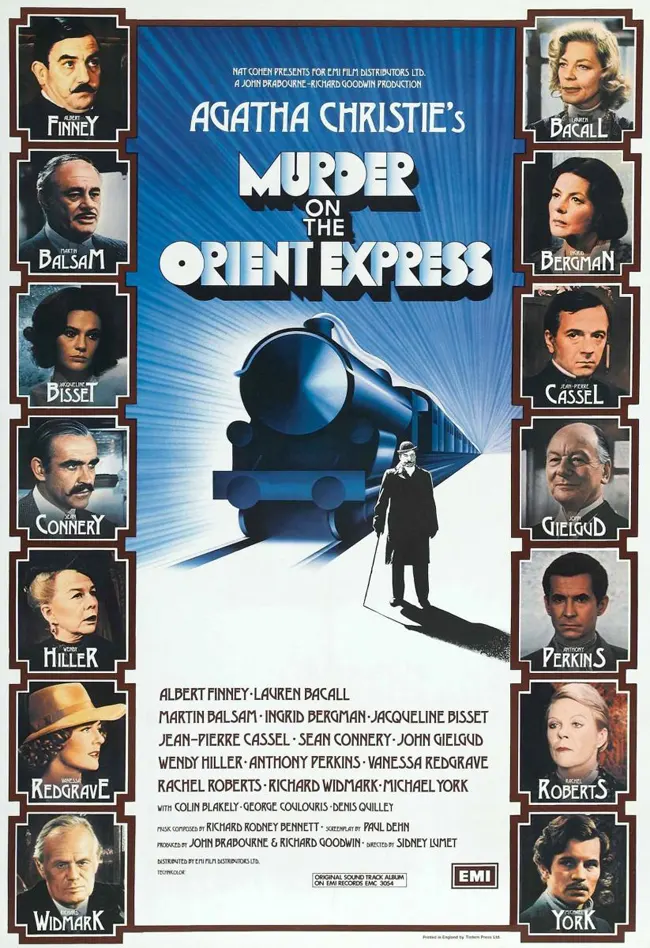
But Bergman manages to make a very small part in Murder on the Orient Express feel far greater than it perhaps has any right to do. Lumet initially wanted her to play the larger Princess Dragomiroff role but Bergman insisted upon Swedish missionary, Greta Ohlsson.
What’s so compelling is how she can still achieve so much with a character when only on-screen for around 10 minutes of a two-hour movie. There’s a tragic fragility to Greta, whose sanity hangs by a thread. Emotionally unstable, she clings to her religious conviction to maintain some kind of control. Yet, she’s still nervy, her mannerisms somewhat unsettled.
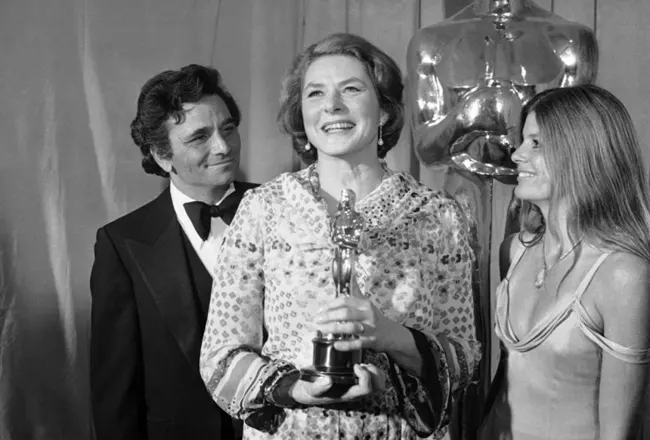
Ingrid Bergman after collecting her Academy Award at the 47th Oscars.
Her main scene, which lasts for around five minutes, and sees Poirot interrogating her, showcases an actor whose ability and range requires little theatrical intervention. The camera simply needs to capture it. Lumet only subtly tracks to the the right as Poirot’s back briefly blocks Greta from view. Otherwise, Bergman is on-screen – in a mid-shot, sat on a train compartment bench – for the entirety of the scene without a single cut.
Much of the beauty of these few moments – and the performance – is not in what Bergman expresses with words but what she conveys with her facial expressions. She can be quietly convincing and frenetically manic, her eyes at times locked on to Poirot’s with forceful determination and at other times darting around the compartment chasing flies that aren’t there.
It’s difficult to imagine anyone capturing Greta’s broken English vulnerability quite like Bergman. There are so many layers to this character and that depth is so naturally conveyed. But she’s also a suspect in a murder-mystery. Yet, despite her erratic state and religious deference, we find sympathy in a character who is clearly hiding something.
On the performance, Lumet said: “Since her part was so small, I decided to film her one big scene, where she talks for almost five minutes, straight, all in one long take. A lot of actresses would have hesitated over that. She loved the idea and made the most of it. She ran the gamut of emotions. I’ve never seen anything like it.”
This post was written as part of The Wonderful World of Cinema’s Ingrid Bergman blogathon.













Wow, that was a wonderfully written article. Thank you! Although this never necessarily was one of my most favourite Ingrid Bergman performances, I loved how you analysed it and explained why it was worthy of the Oscar. Oh and I love that photo of her with Peter Falk and Katharine Ross! Thanks so much for taking part in the blogathon. 🙂
One of the many reasons I dislike the Oscars is that people are often so butthurt about their faves getting snubbed that they’ll poo-poo good or even great performances out of envy. It seems like that was very much the case here.
I’ve never seen MURDER ON THE ORIENT EXPRESS but your description of Bergman’s performance alone, brief as it is, has intrigued me.
I love this quote, as it captures her talent so well. You’re right that her “ability and range requires little theatrical intervention. The camera simply needs to capture it.” Thank you for including the clip. I’d forgotten how much I loved this performance!
I’ve been meaning to see this version of Orient Express for years, and you have just bumped it way higher on my need-to-watch list. Great exploration of Bergman’s contribution!
Yes, absolutely! Ingrid’s performance here is a masterclass in acting. To cast such a long shadow with such little screen time is talent and skill, indeed. I hadn’t thought about this film in a long time, but now you’ve got me anxious to see it again ASAP.
I’ve always been interested in seeing Murder on the Orient Express, and now I’m bumping it up on my watchlist. Thank you for this excellent post — I look forward to seeing Bergman’s performance (which, I admit, I didn’t even know she won an Oscar for!).
— Karen