
 By
By 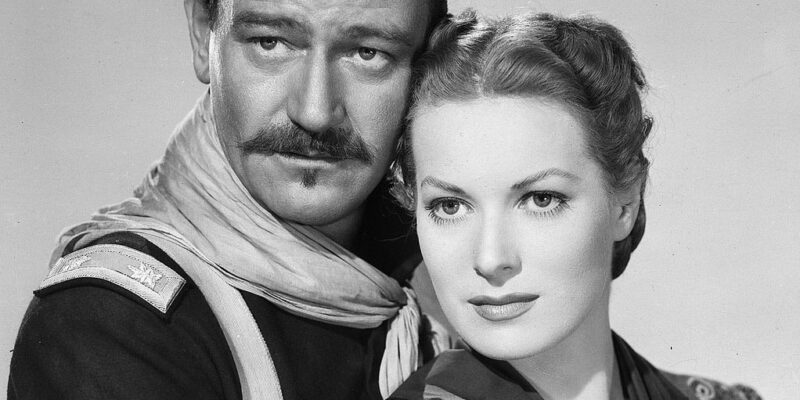
If there’s one thing John Wayne obviously wanted to make clear while he was alive it’s that fatherhood is a tough gig.
Being the patriarch, according to The Duke, can sometimes be so difficult there are moments when its misunderstood love manifests itself as harsh discipline.
Fulfilling one’s role as the proverbial head of the family – the iconic actor repeatedly suggested in a number of his movies (particularly those made during the second half of his career) – meant naggingly cruelty was actually kindness in disguise, regardless of how annoying it might all be for the targeted chips off the old block.
Be it the errant dad, the dominant male role model or the crotchety hard task master, a good number of the father figures Wayne played were undeniably pig headed and flawed.
They made up for this, however, with their better judgement, which was usually pretty sound – especially when their seemingly unsympathetic toughness was laced with an old fashioned sense of practical nobility that today seems to have been relegated to a bygone era.
Take Otto Preminger’s 1965 World War II black and white saga In Harm’s Way for instance.
As naval commander Rockwell “Rock” Torrey, The Duke not only finds himself in charge of his estranged son Jeremiah (Brandon de Wilde), but ends up sending the young man to his death during a battle with the advancing Japanese somewhere in the Pacific.
Then, in George Sherman’s 1971 horse opera Big Jake, Wayne’s titular character Jacob McCandles has serious problems with his eldest boy James (Patrick Wayne), whom he has to lead on a rescue mission to retrieve his grandson (Little Jake, played Ethan Wayne) from the clutches of outlaw kidnapper John Fain (Richard Boone).
A year later, in Mark Rydell’s oater The Cowboys (1972), the Hollywood legend does not play a dad, but a tough-as-nails aging rancher who has to quickly turn a bunch of inexperienced school boys into farm hands so they can help him complete a 400 mile cattle drive.
Finally there’s his last movie – Don Siegel’s The Shootist (1976) – in which a cancer-riddled gunfighter (Wayne of course) decides to tie up few loose ends and go out in a blaze of glory in the process, along the way teaching the fatherless Gillom Rogers (Ron Howard) the ways of being a man.
Familiar territory
Of these four works John Ford’s Rio Grande (1950) resembles In Harm’s Way the most insofar as it too is about a US military officer who finds himself commanding his estranged son in the middle of a conflict zone.
Unlike the Preminger film, though, Wayne’s character has a glaring sentimental streak running through him – something that at time borders precariously close to maudlin, but at others manages to make this toughest of lead men seem quite appealing.
This time The Duke plays Lieutenant Colonel Kirby Yorke, the head of a Texas cavalry fort located within the vicinity of the titular river, whose brief is primarily to defend the white settlers from marauding Apaches.
Yorke’s I’m–the-guy-in-charge-here life, however, is complicated with the arrival of his estranged son Jefferson (Claude Jarman Jnr) who, unbeknown to his father, enlisted as a trooper after bombing out of officers’ training at West Point.
To compound matters, his separated better half Kathleen (Maureen O’Hara) also turns up on the scene – partly to convince her ex to discharge the boy and send him home, but mostly (as it turns out) to stir absent hubby’s loins and rekindle a romance which has been on hold for just over 15 years.
Being a sentimental Ford Western there are no real surprises in the revelation that Kirby not only manages to take all of this in his stride, but secretly enjoys the injection of domestic bliss – proving he is more closet pushover than stoic warrior when it comes to these renewed affairs of the heart.
Despite the fact he talks tough to Jefferson upon his arrival (“On the official record you’re my son,” he says, “but in this post you’re just another trooper; you heard me tell the recruits what I need from them – twice that I will expect from you”), it quickly becomes obvious Kirby has a hidden soft spot for junior, although he wisely steers clear of the boy’s rite of passage.
Additionally, The Duke makes it no secret he still has strong feelings for Kathleen, telling her straight off the bat that “you’re a fine figure of a woman” as if it is going to be some kind of problem. (A little later, and well before they re-consummate their romance, Kirby humorously refers to his wife as “the colonel’s lady”.)
All of this melodrama eventually seeps into the movie’s second half, when the war with the local Indians heats up and the regiment eventually finds itself having to rescue a group of stolen children – a plot thread Ford brought to the fore a few years later in his seminal 1956 Western The Searchers.
Mixed vision
Despite having not seen the first two instalments of the director’s so-called cavalry trilogy – of which Rio Grande is the third part (after Fort Apache [1948] and She Wore a Yellow Ribbon the following year) – it is reasonably safe to assume what the overall tenor of this frontier saga is given the reverence chapter three has for its leading actors and subject matter.
Ford’s love of the cavalry and its horsemanship; his feel for the sense of community amongst the troops; his appreciation for the mournful sadness and inherent dangers which come with pioneer life; his penchant for majestic outcropping vistas and calculated use of deep focus compositions – when put together this all amounts to what could well be one of his most personal visions of the old West.
Unfortunately, when looked at in a modern context, Rio Grande is undeniably racist, depicting First Nations folks as either not-so-noble-savages, incarcerated prisoners awaiting justice or compliant turncoat army scouts.
Indeed, during the movie’s first 10 minutes, Kirby makes it clear he is effectively policing murderers and heathens when he reports to General Philip Sheridan (J Carrol Naish in a role which would have suited Jason Robards) that three of his troops were killed and left staked face down on ant hills while guarding the water holes, his gripe pinpointing who the real savages are.
Putting archaic xenophobia aside for one moment, Rio Grande also suffers from a few other problems which reflect the film’s age.
The first is the repeated appearance of The Sons of the Pioneers, a group of guitar-accompanied crooners who belt out a few slow numbers at appropriate moments. As this is a 70 year old Hollywood film, the inclusion of one song is perhaps forgivable. After that, though, their presence becomes tedious and tends to bog the whole thing down.
Then there’s Rio Grande’s opening credits, when Ford sees fit to include background shots which are later reused in the movie during a scene wherein Kirby and his entourage meet a Mexican lieutenant (Alberto Morin) in the middle of the river.
While not an entirely inconsequential moment in the story (it highlights the fact the US commander has a healthy degree of respect for his southern counterpart – so much so that he gladly offers to “place myself and my men under your command” if it means he can continue chasing the fleeing Indians into Mexico), it is not so thematically important as to warrant a double reference.
Yet this is exactly what Ford does – he refers to it twice. And, in doing so, he effectively gives the scene some unintended (and ultimately misleading) credence; all because (possibly) he was too lazy to go out and shoot suitable visual material for the credits while assuming his collective audience, with its 1950 sensibilities, simply wouldn’t bother making the connection.
Ultimately, Ford redeems himself by making sure The Duke – in what could easily be construed as a love story by proxy – harbours an undeniable tender streak which can’t be hidden or ruined by macho bluff and bluster.
Finally seeing one of his characters admit that being a father, or at least a dominant male role model, isn’t all that bad is something of a welcome relief for those who were brought up watching Wayne insist that personal suffering at the hands of a patriarchal tyrant is just another necessary step on the path to adulthood.

Top 10 Films reviewed Rio Grande courtesy of Eureka Entertainment which released the film on Blu-ray in the UK on April 20, 2020. You can buy it on Amazon.co.uk here.







Very nicely written, Mark.
I haven’t seen any of The Duke’s films before, but I’m making an effort to watch films from the 1940s-1960s and have ‘The Searchers’ lined up ready to watch. Are there any other films from Wayne you think I should try and see too? Rio Grande does sound interesting.
Thank you for reading and the feedback. Quite a difference difference between The Duke in Rio Grande and The Searchers (for which he arguably should have won his Oscar). A good starting point – for the Westerns at least – would probably be to check out all of the Wayne/John Ford collaborations (including She Wore a Yellow Ribbon and Fort Apache, which made up the other two parts of this trilogy) and then the Wayne/Howard Hawkes ones. Then maybe whatever is left in his last decade, which included his Oscar winner (True Grit) and The Shootist. The late 60s/early 70s horse operas are a bit hit and miss, but a few of them are fun (like Big Jake, Chisum and The Undefeated). One of his funniest roles, though, is as Genghis Khan in The Conquerer which came out the same year as The Searchers. Some unintended laffs there, although the story goes a lot of the people involved making the thing ended up dying of cancer because a chunk of it was shot in nuclear bomb-testing territory.
Thanks, Mark – appreciate it!
I’ve watched the Jeff Bridges remake of True Grit so would be good to watch the original.
My watchlist has been updated 🙂
Of the few westerns I’ve seen, Rio Grande doesn’t really stand up to repeat viewings for me. Wayne does what Wayne does and I suppose given the conventions of the genre it shouldn’t be a surprise that O’Hara is largely wasted, but I just felt this was off the production line and now, looking back, it gets lost amongst the many far more interesting examples of the genre. Maybe I’m speaking out of turn by naming the likes of High Noon, Butch Cassidy, The Wild Bunch, and Once Upon A Time in the West as preferable, and will get attacked by genre die-hards, but they’re certainly ahead in the queue when I’m considering a western to watch.
I don’t disagree, although (1) Rio Grande is perhaps a little too personal to be considered strictly production line (Wayne’s late 1960s/early 1970s stuff falls more within this category, while Ford’s The Horse Soldiers, which was also made in 1950s, doesn’t have much zing), and (2) I’d add The Good, the Bad and the Ugly and Unforgiven to the list of gotta-see classic westerns. In addition, a few of the 1970s anti-Westerns also deserve a hearing – Altman’s McCabe and Mrs Miller, Aldrich’s Alzana’s Raid and Penn’s Little Big Man come to mind. Thanks for reading – always good to hear your thoughts.