
 By
By 
The 1960s saw horror become a genre that could finally be taken seriously. Before that it was cinema’s sideshow, distinguished by villains who were more silly than scary. In the years leading up the American New Wave, horror took on a new guise, holding a mirror up to society and displaying its most terrifying indiscretions.
There was a seriousness to the genre that largely wasn’t there previously which came to a head when actor Duane Jones’ Ben – a black man – in Night of the Living Dead was killed by white mob after previously surviving an zombie siege. George A. Romero’s film, released in 1968, bookended a new age of horror movies and laid the groundwork for the pioneering works that would appear in cinemas in the 1970s.
In this list, we celebrate a selection of those great horror movies that appeared in a golden age for the genre in the 1960s and 1970s.
The Wicker Man
Dir. Robin Hardy (1973, UK)

Mad is one way to describe this unsettling masterpiece from director Robin Hardy. The appearance of Christopher Lee, his celebrity alive with the glorious blood red of Hammer horror, might suggest the artificiality of the famed British studio’s dalliance with camp, and the collective audience snigger that accompanies such creative indulgence, but nothing could be further from the truth. In fact, The Wicker Man is so unassuming you’d be forgiven for forgetting that you were indeed watching a horror film; an exceptionally frightening one at that.
Part of the film’s obscure charm, moreover its ability to nestle itself under your skin, is that for much of the story you’re as clueless as well-meaning detective Sgt. Neil Howie (Edward Woodward). Not only is he, and us the audience, no closer to solving the mystery of a missing girl, thanks to the islanders conspiring to thwart his attempts at every opportunity, but we become increasingly fascinated with the inhabitants of Summerisle despite our understanding of their motivations, and their pagan rituals, growing more distant with every new development. It is therefore somewhat alarming to feel a kinship with the islanders, as if they are liberated by their values in a way that Howie is not. It muddies the line between hero and villain, interestingly developing these characteristics in both its protagonist and antagonist.

At its heart, The Wicker Man engrosses thanks to Howie’s determined attempts to find the missing girl, alongside Woodward’s mild-mannered but increasingly desperate pursuit of the truth. His self-conscious moral virtue is upended by Summerisle’s free spirit and collective enrichment of life while he himself is constrained by his devout Christian beliefs. Underlining this is director Hardy’s wry wit and the disconcerting sense of imbalance between seemingly harmless religious ritual and darker, sexual or violent subtext. There is also the brilliant Christopher Lee as the island’s patriarch and spiritual leader. The seasoned actor mixes brief moments of lunacy (his haphazard, childlike dance at the head of a parade during the film’s final act) with an unwavering, imposing belief in his system of values.
Shivers
Dir. David Cronenberg (1975, Canada)

Shivers is one of many body-horror films from talented writer-director David Cronenberg. The film, which looks at a parasite that infects a number of people in a Montreal apartment block, is a reaction to changing attitudes towards sex during the 1970s. The parasite in question causes in its hosts an uncontrollable sexual appetite and is passed through sexual intercourse.
Night Of The Living Dead & Dawn Of The Dead
Dir. George A. Romero (1968 / 1978, USA)

George A. Romero’s hugely influential 1968 horror film not only ushered in a new dawn for the zombie film, it paved the way to gore cinema and low-budget exploitation. The slasher films of the 1970s wouldn’t have been made without Night of the Living Dead. Followed by one of the best sequels of all time, the director reinforced the indelible legacy of Night of the Living Dead with the equally intelligent and suitably gory Dawn of the Dead. The poster declared “When there’s no more room in hell the dead will walk the earth” or more precisely “the Mall” as Romero used the film to comment on American society’s gross commercialisation and the increasing dominance of consumerism.
Witchfinder General
Dir. Michael Reeves (1968, UK)

Witchfinder General was destined to become a cult hit. It was heavily censored, initially ignored by critics and audiences who were dismayed at the onscreen violence, and poorly marketed with the American release changing its title to The Conqueror Worm in order to tie it in with Roger Corman’s collaborations with Vincent Price in adapting Edgar Allan Poe’s work. When the film’s director Michael Reeves died of a drug overdose, aged 25, only nine months after the film was released, it seemed likely that Witchfinder General would become a lost British horror, destined to be forgotten.
But all these drawbacks played into its favour. After all, bad publicity is sometimes the sort of publicity a film, particularly a horror movie, needs to kick-start its momentum. Indeed, its violence, once too much for audiences not acclimatised to such visual carnage, would become an intrinsic part of its later success, just as its critical re-evaluation would ignite a newfound appreciation of this classic film.
It tells the fictionalised tale of 17th century English lawyer Matthew Hopkins who, appointed by the State, sets out across the country to find those supposedly practising witchcraft. His methods of torture often bring death to those he accuses of dark magic whether or not they prove his theory. An opportunist more than anything, he’s a malevolent force who takes advantage of social upheaval and the preoccupations of the government during the English Civil War, to enact a perverse, nihilistic pleasure in the destruction of others.
The Devil Rides Out
Dir. Terence Fisher (1968, UK)

The Devil Rides Out, known as The Devil’s Bride in America, was deemed too unsettling for an early 1960s British audience. This saw the project shelved for four years until censorship was relaxed in regards to depictions of the occult.
Starring Christopher Lee (in what he has called his favourite role) alongside Charles Gray, Patrick Mower and Paul Eddington, this icy supernatural horror deals with the dark subject of devil-worship as Lee, somewhat surprisingly, sides with the “good guys”.
It is illuminating that Lee himself cites this 1968 British horror classic as one of his best given the array of brilliant work he did for Hammer and, of course, 1973’s incredible The Wicker Man.
In The Devil Rides Out, directed by Hammer stalwart Terence Fisher, we see Lee play the suave Nicholas, Duc de Richleau, who begins to investigate the strange goings-on at the home of Simon Aron (Patrick Mower), a young man Nicholas swore to protect for a long-term friend. Simon appears to have become involved with a satanic cult as Nicholas finds macabre markings at his home in the countryside accompanied by a sacrificial white hen and black cockerel.
Nicholas, along with friend Rex Van Ryn (played by Leon Greene but dubbed by Patrick Allen), investigates and finds himself thrown into the middle of a ritual to raise the Devil in order to officially initiate Simon and fellow newcomer Tanith (Niké Arrighi) into the group.
The film is one of the best Hammer ever did during its heyday and it comes as little surprise to learn it’s one of Lee’s proudest pieces of work. While it suffers from some dodgy special effects and unwelcome moments of camp, Lee is genuinely brilliant as a multi-layered “good guy” while the devil’s fleeting appearance is one of the most unsettling incarnations of Satan in cinema.
There’s also a number of stand out scenes, often cited as some of director Fisher’s best moments behind the camera, such as the evil Mocata (Charles Gray) hypnotically possessing Marie Eaton (Sarah Lawson). This all goes to making The Devil Rides Out one of the best British horror movies of all time.
Black Christmas
Dir. Bob Clark (1974, Canada)
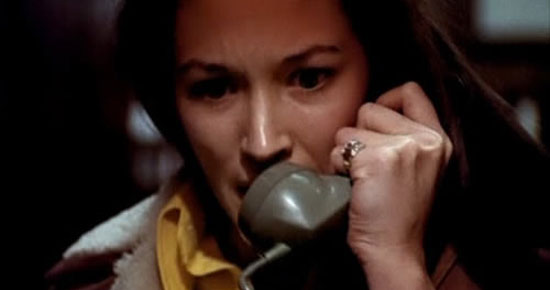
Pre-dating Halloween, Bob Clark’s Black Christmas could be argued as the first slasher film. It provided John Carpenter with a few ideas about point of view camerawork and the idea of a crazed killer stalking nubile college students. It’s a terrifically well-made film with Clark’s subjective camera placing the audience within the viewpoint of the killer.
He also used a 30mm anamorphic, wide-angle lens to increase the scope of the visible image. This was coupled with stylistic tricks to distort the audience’s interpretation of the story as it unfolds, adding to the sense of paranoia and fear (this included low-angle shots as well as unusual pans and tracking shots marked by a consistently moving camera).
Peeping Tom
Dir. Michael Powell (1960, UK)
 Like a number of horror films, Peeping Tom’s reputation grew only after having suffered a critical backlash that saw the film almost disappear into obscurity. English director Michael Powell was a much-celebrated filmmaker thanks to his successful collaborations with Emeric Pressburger that saw them release some of the 1940s most memorable films such as The Life and Death of Colonel Blimp, A Matter of Life and Death, Black Narcissus and The Red Shoes.
However, when Powell decided to work with former World War II cryptographer and polymath Leo Marks on his 1960 film Peeping Tom, the result wasn’t as expected. The story of a voyeuristic psychopath filming his murderous rampage was annihilated by the critics of the day. The anti-Peeping Tom vitriol was so great, Powell could not work in Britain anymore.
The film was revived in part thanks to Martin Scorsese’s love of Powell’s work with the film later gaining a following in America and also elsewhere in Europe where, for example, French critics were particularly fascinated by Powell’s depiction of a sympathetic villain (indeed, a sadistic murderer no less). Many of the film’s biggest fans claim British critics hated the film on its initial release because they were ashamed to have felt sympathy towards a villain who carries out such atrocious acts.
That’s what makes the film so fascinating. In 1960, it was ahead of its time, not least in its enigmatic depiction of the villain but also in its point-of-view photography which immersed the audience in the story. There’s a wit to Powell’s work here, one that challenges the audience as active participants in the killer’s voyeurism. Irony is also not lost on the director whose stylistic choices are born from both a love and a fear of the art form he had made a career out of.
The Brood
Dir. David Cronenberg (1978, Canada)

For my money this is David Cronenberg’s best work. It’s a captivating horror-drama with strong characterisation and some suitably odd yet significantly frightening sequences.
Cronenberg maintains a cold, almost distant tone that mimics the frosty expanse of the Ontario locations. The film follows a sort of parental struggle between a concerned father (Frank played by Art Hindle) and an institutionalised mother (Nola played by Samantha Edgar) as the care of their daughter comes under scrutiny given Nola’s unstable mental state and the fact she is currently undergoing a new but mysterious type of treatment from an unconventional psychotherapist played by Oliver Reed.
The Haunting
Dir. Robert Wise (1963, UK)

Well-received on its original release in 1961, Robert Wise’s The Haunting has since been called one of the greatest and scariest horror films ever made by such esteemed filmmakers as Martin Scorsese. Most modern audiences will know the story thanks to Jan de Bont’s awful 1999 remake in which a penchant for modern digital effects destroys any subtly the film may have had.
The original, adapted by Nelson Gidding from the novel The Haunting of Hill House by Shirley Jackson, is a meditation on technical ingenuity. Director Wise credits production designer Elliot Scott for his interior sets which helped create a sense of claustrophobia to add to the supernatural occurrences. Surprisingly, instead of creating dark corners within the frame, Wise deliberately set up the interior scenes to be brightly lit so audiences could see all aspects of the frame.
He also used a 30mm anamorphic, wide-angle lens to increase the scope of the visible image. This was coupled with stylistic tricks to distort the audience’s interpretation of the story as it unfolds, adding to the sense of paranoia and fear (this included low-angle shots as well as unusual pans and tracking shots marked by a consistently moving camera).
Don’t Look Now
Dir. Nicolas Roeg (1973, UK)
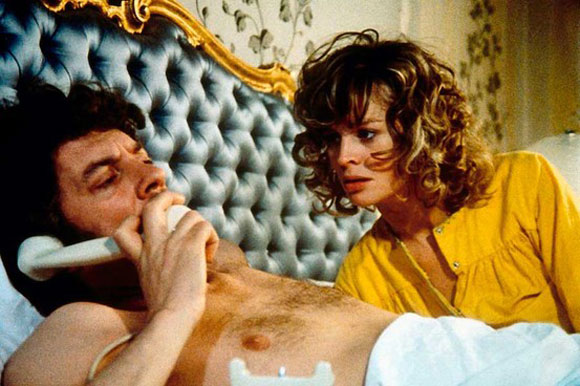
Similar to The Wicker Man, Nicolas Roeg’s film has an ending that will shock, infuriate, and unnerve. Telling the story of a couple who have yet to recover from the trauma of losing their daughter to drowning, Laura (Julie Christie) and John (Donald Sutherland) have retreated to Europe while John works on the restoration of a church in Venice.
Laura begins meeting a clairvoyant who claims to be in contact with their dead daughter. As Laura becomes more obsessed with the possibility of speaking to their child beyond the grave, John is distanced, disbelieving in such activity. But he keeps seeing a figure in a red coat who resembles his child.
Questioning his own sanity the film climaxes with one of the most memorable final sequences in horror cinema. Roeg’s use of visual motifs and the Venetian backdrop make Don’t Look Now a visually spectacular horror movie, and one that lingers in the mind long after the credits have rolled.
The Texas Chainsaw Massacre
Dir. Tobe Hooper (1974, USA)

Tobe Hooper’s The Texas Chainsaw Massacre is a tour-de-force of implied violence. It’s a film perceived as being gory but its physical violence is largely without the blood and guts of gore cinema’s most renowned entries. Nevertheless, The Texas Chainsaw Massacre takes no prisoners (well, apart from the unfortunate group who find their way into the cannibal family’s home).
Blood On Satan’s Claw
Dir. Piers Haggard (1971, UK)

When looking at the best British horror films, Blood on Satan’s Claw is a film that has to join the discussion. It follows in the footsteps of Witchfinder General before it and The Wicker Man after it, and is part of what actor, writer and fan Mark Gatiss calls the short-lived “folk horror” genre that depicted malevolent manifestation in the serene, tranquil surroundings of a green English countryside. In Witchfinder General it was torture and murder, in The Wicker Man it was pagan ritual and sacrifice, in Blood on Satan’s Claw it’s the reincarnation of the devil.
Made by Tigon British Film Productions and directed by Piers Haggard, the film was a box office disappointment. It didn’t make much money bemoans its director who, like Robin Hardy with The Wicker Man, found distribution and marketing a real challenge. However, the film has become a cult favourite, not least because it features an unforgettable but particularly hellish rape and torture scene (the sort of dispiriting sequence Straw Dogs became well known for). It’s also genuinely unsettling from the outset with its sense of ambiguity feeding an uneasy, discomforting tone.
Carrie
Dir. Brian De Palma (1976, USA)

Brian De Palma is well-known to casual film fans for The Untouchables and Scarface but his work in horror and Hitchcockian suspense should not be underestimated.
Dressed To Kill is a love-letter to Hitchcock, and a brilliant one at that; Blow Out is a hugely underrated thriller that yet again highlights De Palma’s skills with camera movement, split-screen, and imaginative use of mise-en-scene; and Sisters and The Fury are as frightening as anything on this list.
Just ahead of them all, however, is the director’s adaptation of Stephen King’s debut novel Carrie. The story, about a shy teenage girl who uses her newly found telekinetic skills to gain revenge against the bullies who humiliate her, is a note-perfect exercise in visceral horror.
Sissy Spacek is excellent in the role of Carrie (innocent fragility housing a frightening power), but it’s her fanatically religious mother, played by Piper Laurie, who stands out (a fire and brimstone fundamentalist who imprisons her daughter through a relentless verbal lashing cured on cruel and archaic religious doctrine).
Halloween
Dir. John Carpenter (1978, USA)

In 1997, Wes Craven released Scream. It was a film targeted at the youth market – a market that hadn’t seen a quality slasher film released for years. That said, not many who saw and loved Craven’s homage to the slasher genre knew much about the movies it was referencing. But the film, and the success of the sequels and new-age slashers, are in debt to one of John Carpenter’s greatest releases – Halloween.
It isn’t the first slasher film but it is the best. Alfred Hitchcock made the Granddaddy of the genre with Psycho, and this was followed in the early 1970s by Tobe Hooper’s The Texas Chainsaw Massacre and Bob Clark’s Black Christmas which were both hugely influential on Carpenter. He deconstructed the template which had made those films successful and set the conventions which Scream would so shrewdly mock and simultaneously celebrate.
Halloween is so effective because it depicts a monster which is at once unstoppable and seemingly without reason. It was a similar conceit that made the terror of The Texas Chainsaw Massacre so alarming – not just the ferocity of it but the fact it lacked motivation and therefore reason. It was horror born of undiluted, indefinable, and deep-rooted evil. Halloween benefits from its monster – Michael Myers – one of the most iconic antagonists ever envisaged.
Carpenter’s suggestive use of the killer’s point of view and exploitation of a promiscuous youth struck a chord with audiences at the time, especially young audiences, which lingers even today. And its chief antagonist – Michael Myers – has become an iconic star of the genre in his own right.
Rosemary’s Baby
Dir. Roman Polanski (1968, USA)

Roman Polanski brings Ira Levin’s bestselling 1967 novel to the screen with a beautifully realised foreboding atmosphere and an understated, fragile performance from Mia Farrow.
The story tells of a struggling actor who befriends an odd couple who practice the art of witchcraft. In return for his wife, unknowingly, being impregnated by the devil’s they will ensure his acting career takes off.
It’s a chilling premise, its subtle terrors not immediately acknowledged and thus left to slow-burn as the tension builds and the pregnant woman’s suspicions – and paranoia – grow in intensity.
Ruth Gordon is great as the insidious neighbour – her sugar-sweet smiles and good graces hiding a vicious malevolence. What makes Rosemary’s Baby stand out is how it drops gothic styling is favour of an urban realism that would become de rigueur in contemporary horror of the approaching decade.
The Innocents
Dir. Jack Clayton (1961, UK)

The influence of The Innocents cannot be ignored. Jack Clayton’s adaptation of Henry James’ novella The Turn of the Screw took the horror genre in a new direction. Through its ornate depiction of late 19th century gothic, the film balances classical familial melodrama in a setting of unfamiliar macabre. Underlining it all is an ambiguous battle between the supernatural and the psychological, the tangible and the intangible.
The Innocents took its subject matter, which includes the strong possibility of paranormal activity occurring in a lavish English countryside mansion, with a seriousness not often seen within the genre prior to 1961. Previous attempts to popularise horror saw very discernible villains do battle with the power of good (the early Universal monster movies like Dracula and Frankenstein with Bela Legosi and Boris Karloff in the 1930s, or Hammer’s movies with Christopher Lee and Peter Cushing in the 1950s) leaving less to the imagination in favour of visceral shocks and, latterly, when colour film became prevalent, blood-red gore. The Innocents strips away the artificiality of these monster movies in order to offer something far more riveting. Indeed, in Clayton’s film it isn’t clear who the villain of the piece really is.

Deborah Kerr in The Innocents as the sexually repressed governess Miss Giddens.
It is in this enigmatic prose that the film draws its ability to unnerve and disarm the audience. Much of its success comes from its technical ingenuity such as the use of the wide, letterbox frame to create a sense of spatial disorientation (you never know what might be in the corners) while deep focus and slow dissolves add an immediacy to the drama and an ethereal quality respectively.
Deborah Kerr is also brilliant as the sexually repressed governess Miss Giddens. As the traumatic experiences slowly crack at her strength of character, her psychological downward spiral becomes a captivating emotional struggle. Despite an unrelenting determination to do the right thing for the children in her charge, her antagonist remains distinctly enigmatic. It makes for an experience that unsettles the mind in much the same way as Miss Giddens’ tranquil existence is rattled by the events that take place.
The Exorcist
Dir. William Friedkin (1973, USA)

The Exorcist is more than a movie. It’s a cultural phenomenon. And the “curse” that has followed it like a bad smell feeds into its legacy. While its tag as one of the greatest horror movies has hindered its relationship with new contemporary audiences whose preconceptions have left them dismissing – or simply not noticing – its subtle qualities, it is a title it truly deserves.
William Friedkin’s The Exorcist terrified audiences so much some left the theatre. Infamously unavailable in the UK because of the “Video Nasty” scare, the film, which already had a huge following after its initial theatrical run, grew in mystique throughout its hiatus from British viewing screens.

The Exorcist is set in Georgetown, Washington where a young girl begins to exhibit strange, sometimes destructive, behaviour. Despite the best intentions of her loving mother and a number of leading doctors, the cause of the problem cannot be found. However, a number of religious clues lead the girl’s mother to consider an alternative form of cure.
She seeks the help of a local priest who works as a psychiatrist at the nearby hospital, believing it to be her final hope. Although the priest, Father Karras, is struggling to come to terms with his faith in the aftermath of his own mother’s death, he meets the young girl and determines the best course of action is to perform an exorcism.
Friedkin was the perfect director for the film. He was enjoying the height of his creative power in the early 1970s and significantly didn’t believe a word of William Peter Blatty’s exorcism ritual. What he did believe in was the mother’s struggle to protect her precious daughter and her ultimate inability to protect her.

He also believed in Father Karras’ story – a man blighted by guilt over his mother’s death. Karras battles the notion that the God he had put so much faith in had let him and his mother down. Now he is faced with a situation that muddies the line between his profession as a psychiatrist and his long held belief system. He must decide whether to rely on his training as a shrink or his faith as a Catholic to save the life of an innocent child. This is all part of what makes the monster so frightening before you consider the film’s more graphically unsettling sequences.
Indeed, while many people remember the young girl stabbing herself with the crucifix or levitating from the bed or watching as her head spins around or, if you’ve scene the extended cut, the spider walk, one of the best visual moments in the film is one of its most subtle.
After Father Karras’ initial consultation with the girl he is called back to see her in the middle of the night where he is shown a curious abrasion on the girl’s stomach. Looking closer the thinly raised skin reveals itself to spell – “Help Me”.

It is chillingly effective, hinting at the voiceless victim who desperately calls for help but cannot make himself heard. It is like being buried inside your own body with all your faculties at your fingertips but a complete inability to use them.











This is a wonderfully written article