
 By
By Around the time he was infusing B-Grade Hollywood sensibilities with the works of Edgar Allan Poe, Roger Corman also directed a nifty little cautionary tale which ends up being so apocalyptic it could well have piqued the interest of Chilean surrealist Alejandro Jodorowsky.
Whilst Corman – who happily is regarded as one of American cinema’s pioneers – isn’t exactly in Jodorowsky’s bizarre league, there are moments when his 1963 opus X (commonly known as The Man with the X-Ray Eyes) wouldn’t look entirely out of place if it suddenly appeared in the South American’s ambitious cinematic oeuvre.
Not that X is full of excessive surrealism or grotesque images; nor is it too seriously obsessed with iconography (religious or otherwise).
Furthermore, it’s doesn’t come across as being a particularly self-indulgent movie.
What it is, though, is hallucinogenic – spotlighting some of the underlying spiritual forces driving humanity and, in doing so, exposing the greed, desire, desperation and superstition which constantly barrage (and, usually in Jodorowsky’s world at least, confound) society’s collective psyche.
As a result, the film travels to the outer boundaries of reality in a narrative akin to some kind of bad drug-induced trip, where the journey seems to get incrementally worse with each bend in the road. Bearing this in mind, it’s fair to say X is something of a precursor to Corman’s psychedelic 1967 counter culture opus The Trip, in which a pre-Easy Rider Peter Fonda drops some LSD as he looks for life’s answers, only to have his acid-laced thoughts turn on him.
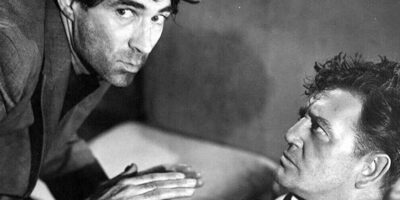
In this case the human experiment comes in the form of Dr James Xavier (Ray Milland), an eye specialist who develops a serum with the power to significantly enhance vision.
Although he initially appears to be a normal man of science, it quickly becomes obvious there are a few kinks in his armour, particularly when he tells a work colleague that he is “closing in on God,” ominously suggesting a Frankenstein element will feature somewhere in this story – which it does.
Mindful that the funding for his unorthodox research might be cut off by the medical foundation underwriting it, an impatient Xavier ignores the protestations of his fellow practitioners (Diana van der Vlis and Harold J Stone) and tests the new liquid technology on himself.
From here on in it’s all downhill for the good doctor as the forces of addiction (not to mention the deleterious side effects of his insatiable thirst for knowledge) take over – a tragic development given these new-found X-ray powers also have the potential to give him healing abilities beyond anyone’s wildest imagination.
Desperate greed
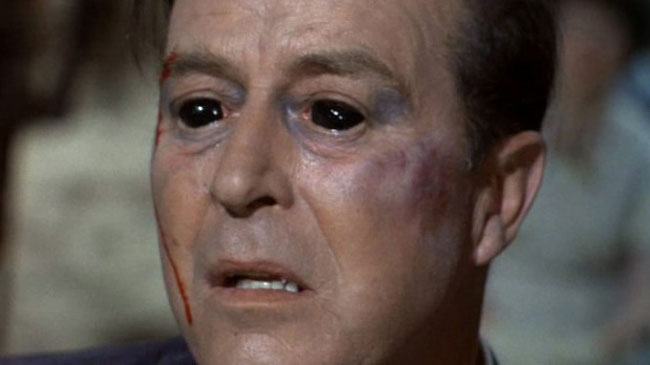
Unable to stop himself from squirting drops into his eyes, Xavier performs some life-saving surgery on a child, but as a result finds himself threatened with a malpractice suit by his superior Dr Benson (John Hoyt); this before accidently killing his good friend Dr Brandt (Stone) by pushing him out of a hospital window somewhere around the fifth floor. Becoming an accused murderer, the mad scientist is forced to go on the lam, taking with him both an out-of-control visual affliction and his stash of goodies.
It’s at juncture that X veers into Jodorowsky territory, where it more or less stays for the remainder of the film, as Xavier first takes refuge in an amusement park down at “the pier”, before deciding to flee to Mexico with Diane Fairfax (van der Vlis) – a road trip which sees them stop off at Las Vegas on the way to raise a little easy cash.
Starting out as Mentallo,* a mind reader in the Mystic Science Temple, the fugitive is relieved of his sideshow duties after his quick talking huckster boss Cane (Don Rickles) recognises his true abilities and re-markets him as “The Healer”, whereby he “consults” members of society’s elderly and poor about their individual ailments in a dingy urban basement.
Not surprisingly, some of these patients are already at the end of their lives, while others seek solutions to niggling medical-related conditions and fears. On the whole they are essentially sick and desperate people with nowhere else to turn. Needless to say, for this doctor it is a far cry from the comfortable environs of a sterile city hospital laboratory where the staff are permitted to light their cigarettes with Bunsen burners.
Following this grim brush with humanity, Xavier encounters another form of desperation – this time in a Las Vegas casino where, for some inexplicable reason, he completely loses the plot and stupidly exposes his cheating ruse; this despite quickly winning almost $20,000 via a poker machine and the Black Jack table. Does he – with the help of his X-ray vision – see just how spiritually corrupt and soulless the place really is? Possibly, but this point is never really made clear as the already mad scientist slides further into hysteria.
Then, in what becomes the movie’s climatic sequence, Xavier dumps Diane (again) and steals a car, fleeing from a police helicopter during a chase across the changing topography of Nevada’s desert. After crashing the vehicle, he finally stumbles across a travelling church revival show where, under a makeshift awning, a hellfire preacher (John Dierkes) berates him for his sins.
Quoting a much maligned version of Matthew 5:27**, the pastor tells the doctor – who by this time is convinced he can see into the eye of the universe (or something like that) – what he must do in order to repent, this brutal act of contrition concluding the film on what is its one truly terrifying note.
Clear intention
From the movie’s opening moments, with its shot of what is supposed to be a surgically-removed eye floating in a bubbling beaker of red liquid that quickly dissolves into a purple hypnotic swirl pattern, it’s obvious X was made for the horror crowd when it first came out.
What might have taken its target audience by surprise, though, is the fact there is nothing particularly scary about the film; nor is it suspenseful in any dramatic sense of the word. Rather, it’s a drug movie by proxy, dealing with a story wherein addiction runs rife and apparitions are induced not by the supernatural, but with the help of some good old fashioned mind bending chemicals.
Importantly, no matter how illogical he seems to become, Xavier remains reasonably coherent until the bitter end – at one point lamenting the soullessness of the urban wasteland he passes (via the kaleidoscopic lens of Corman’s gimmicky Spectarama) while fleeing to Las Vegas with Diane.
Seeing the city “as if unborn – rising into the sky with fingers of metal”, the mad scientist becomes quite lyrical as he gushes some low rent profundity: “Limbs without flesh. Girders without stone. Signs hanging without support. Wires dipping and swaying without poles. City unborn – flesh dissolved in acid of light. The city of the dead.”
Interestingly, the director revisit this visual landscape during X’s prolonged closing credits in a sequence which is very similar to the final minutes of Martin Scorsese’s 1975 journey-through-hell opus Taxi Driver, where night time New York takes on a similar role to that of the dissolving Los Angeles and Las Vegas skylines in the Corman picture. Putting film buff comparisons aside for a moment, what also helps make this unusual ending (for 1963) compelling enough to sit up and take note is Les Baxter’s ghostly soprano accompaniment on the soundtrack, which is just part of a score that, at times, gives Bernard Herrmann a respectable run for his money.***
Unlike the Scorsese film, though, X’s protagonist isn’t a bonkers outcast, but a medical professional at the top of his game, whose journey into the unknown leads him to his own city of the dead – a fate also bestowed upon some of Jodorowsky’s leading characters.
FOOTNOTES
*This may or may not be the correct spelling – it is, though, what the name sounds like when pronounced.
**The preacher says it is from Matthew, Chapter 5: “If thine eye offends thee, pluck it out.” To be more specific, the line comes from Matthew 5, Chapter 27 and targets adulterers: “If your right eye causes you to sin, gouge it out and throw it away. It is better for you to lose one part of your body than for your whole body to be thrown in hell” (as published in The New International Study Bible [1985] by the Michigan-based The Zondervan Corporation).
***Scorsese’s second feature, Boxcar Bertha (1972), was produced by Corman, so it’s not too far a stretch to make this connection between the two films.
Top 10 Films reviewed The Man With The X-Ray Eyes courtesy of Second Sight which released the film on limited edition Blu-ray featuring new artwork by Graham Humphreys, soft cover book with new writing by Jon Towlson and Allan Bryce, and a new newly recorded interview with Roger Corman.












Comments